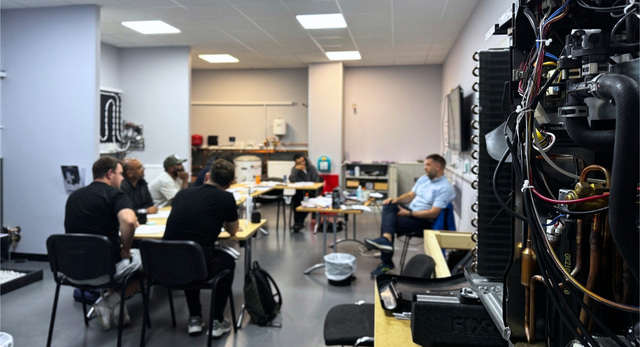

Moving into low carbon does not necessarily mean starting your career again. For gas and heating engineers, existing knowledge of pipework, hot water and heating systems provides a useful foundation for heat pump training.
This article explains what to add next, where F-Gas and MCS fit in.
TL;DR
- Experienced gas and heating engineers can build on existing skills through heat pump training, rather than starting from scratch.
- The heating route usually involves checking existing qualifications, developing low temperature heating competence, then completing an appropriate heat pump qualification.
- Course entry requirements can include water regulations, unvented hot water and evidence of heating installation experience. Gas qualifications alone do not guarantee entry.
- F-Gas training is relevant to regulated work involving fluorinated refrigerants. It is not automatically required for every heat pump installation.
- A heat pump qualification can support MCS certification, but completing a course does not make you or your business MCS certified.
- Solar PV and battery storage are electrical progression routes. Appropriate electrical competence must come before specialist training.
Why Heat Pumps Are a Natural Progression for Gas Engineers
A heat pump changes the heat source, but it still needs a heating system that works properly. In an air-to-water installation, that means suitable pipework, correctly sized emitters, effective controls and a properly commissioned hot water system.
Much of this will be familiar to engineers who install boilers and wet heating systems. Your transferable knowledge may include:
- Installing and assessing wet heating systems.
- Planning pipework and understanding circulation.
- Working with hot water cylinders and heating controls.
- Testing, commissioning and balancing systems.
- Diagnosing heating and hot water faults.
However, being comfortable with boilers does not automatically make you competent with heat pumps. The important change is learning to design and operate the whole system around the heat pump, rather than treating it as a direct boiler replacement.
What changes with low temperature heating?
Heat pumps generally operate more efficiently when they can deliver heat at lower flow temperatures. That makes room-by-room heat loss calculations, emitter selection and hydraulic design central to the job.
For example, an existing radiator might heat a room adequately with a boiler operating at a higher temperature. At the proposed heat pump design temperature, the same radiator may not provide enough output. You need to compare the room’s calculated heat loss with the emitter’s output under the intended operating conditions.
This does not mean every heat pump installation needs new radiators. It means you assess them rather than guess. Pipe sizes, required flow rates, cylinder suitability and control settings also need checking.
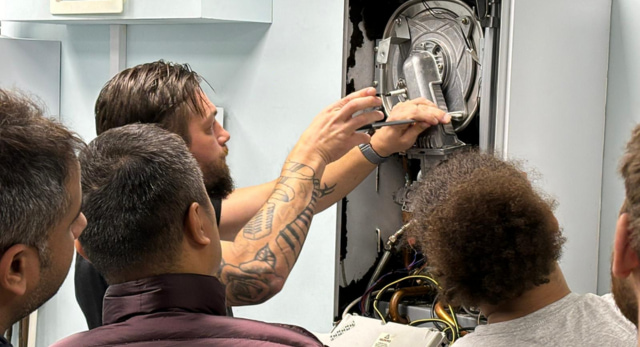
Our heat pump training courses build on existing plumbing and heating competence. They develop the technology-specific knowledge needed for installation, commissioning and maintenance.
How to Become a Heat Pump Installer
For an experienced gas engineer, the route starts with checking existing qualifications and installation experience. From there, you fill any supporting qualification gaps, develop low-temperature heating competence and complete the relevant heat pump training.
The map below shows the main stages. It is a planning guide, not a fixed sequence that applies to every engineer. You may already meet some requirements, while refrigerant work and MCS certification depend on your intended role.
Your low carbon progression map
Select a stage to explore its focus, what to check and the relevant training.
Stage 1: Existing skills
Build on your gas and heating experience
Start by checking the qualifications and practical experience you already hold. This helps identify the supporting training you need before moving into heat pumps.
Focus
Transferable heating competence.
What to check
Your qualifications, installation experience and supporting water regulations and hot water competence.
Stage 2: Low temperature heating
Develop your system design knowledge
This stage focuses on assessing heating and hot water systems for lower operating temperatures, including heat loss, emitter sizing and system design.
Focus
Heat loss, emitters and system design.
What to check
Your ability to assess and design heating and hot water systems for lower operating temperatures.
Stage 3: Heat pump training
Add heat pump installation and maintenance skills
Choose training that matches the technology and work you intend to undertake. Check the qualification’s scope rather than assuming it covers every part of a heat pump system.
Focus
Installation, commissioning and maintenance.
What to check
The technology and activities covered by the qualification, including whether refrigerant circuits are excluded.
Stage 4: MCS pathway
Plan your route to certified installations
Technical training and business certification are separate parts of the progression map. Consider whether you will work through an existing certified business or seek certification for your own business.
Focus
Certified installations and business processes.
What to check
Whether you will work through an existing certified business or seek certification for your own business.
Stage 5: F-Gas where required
Check your intended refrigerant work
This is a conditional stage, not an automatic requirement for every heat pump installation. Your route depends on the refrigerant and the activities you intend to carry out.
Focus
Applicable refrigerant activities.
What to check
The refrigerant, work involved, appropriate individual qualification and any company certification requirement.
This is a general progression map, not a fixed route for every engineer. Your next step depends on your existing qualifications and intended work. F-Gas and MCS apply according to your scope.
What qualifications do you need?
Logic4training’s air source heat pump training offers several entry routes. One is a relevant Level 2 or Level 3 NVQ or SVQ in plumbing, heating and ventilation, gas or oil installation and maintenance.
Another is valid CCN1 and CENWAT qualifications, together with at least two years of verifiable experience installing heating and hot water systems. Servicing experience alone does not meet the installation experience requirement for this route.
The published entry requirements also include:
- Water Regulations.
- Unvented Hot Water, commonly referred to as G3.
- Low Temperature Heating and Hot Water Systems in Dwellings.
Check the current course requirements before booking. If you already hold supporting qualifications, ask the training team to confirm whether they meet the requirements.
Our low temperature heating courses help develop the system design knowledge behind effective heat pump installations. The air source course then provides the LCL Awards Level 3 Award in the Installation and Maintenance of Heat Pump Systems, covering non-refrigerant circuits.
What does practical competence involve?
A successful installation involves more than connecting a unit to existing pipes. You need to assess the property, understand the design, select suitable components and commission the system against that design.
Training covers issues such as outdoor unit siting, airflow, noise assessment, condensate drainage, hydraulic connections, controls and customer handover. Electrical work must also be carried out by someone competent for that work. A heating qualification does not automatically establish electrical installation competence.
Where Does MCS Fit Into the Progression Map?
MCS is a certification pathway for the business delivering renewable installations. A recognised heat pump qualification can help demonstrate technical competence, but it does not automatically make an engineer or business MCS certified.
Think of the distinction this way: training develops what you know and can do. Certification assesses how the business delivers that work against the relevant scheme requirements.
The Energy Saving Trust’s MCS guidance identifies requirements covering technical competence, installation standards, business processes and customer protection.
For heat pumps, MCS separates design and installation requirements through MIS 3005-D and MIS 3005-I. Your business needs to understand its intended scope, including who takes responsibility for system design.
Do you need MCS to install heat pumps?
MCS is not a blanket legal requirement for every heat pump installation. However, it is required for installations delivered through the Boiler Upgrade Scheme in England and Wales. The certified installer applies on the customer’s behalf.
MCS does not replace other obligations. Building Regulations, electrical safety, refrigerant rules and applicable planning requirements still need to be addressed.
You can develop your skills while working for an existing MCS-certified business, or work towards certification for your own business. Where an umbrella arrangement is available, confirm who is responsible for design, supervision, certification and customer obligations. It is not simply permission to use another company’s MCS number.
Our article on becoming MCS certified explains the wider pathway. For the funding context, see our article on Boiler Upgrade Scheme amendments.
Where Does F-Gas Fit Into the Heat Pump Route?
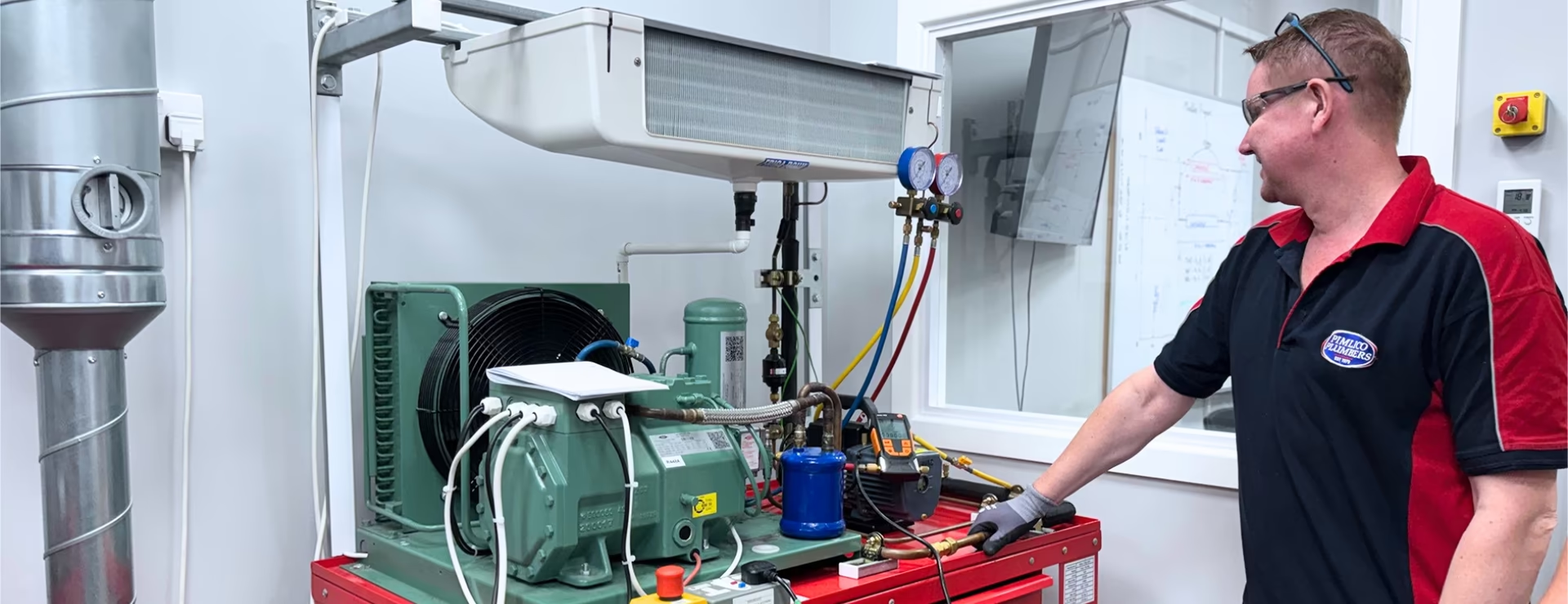
F-Gas training and heat pump training serve different purposes. Heat pump training develops competence in the heating technology and its associated systems. F-Gas qualifications cover specified activities involving fluorinated refrigerants.
The question is not simply, “Am I installing a heat pump?” It is, “Which refrigerant does this equipment contain, and what work will I carry out?”
Under government guidance on F-Gas qualifications, relevant regulated activities include installation, servicing, maintenance, leak checking, refrigerant recovery and decommissioning. The certificate category must cover the activities you undertake.
Monobloc and split systems
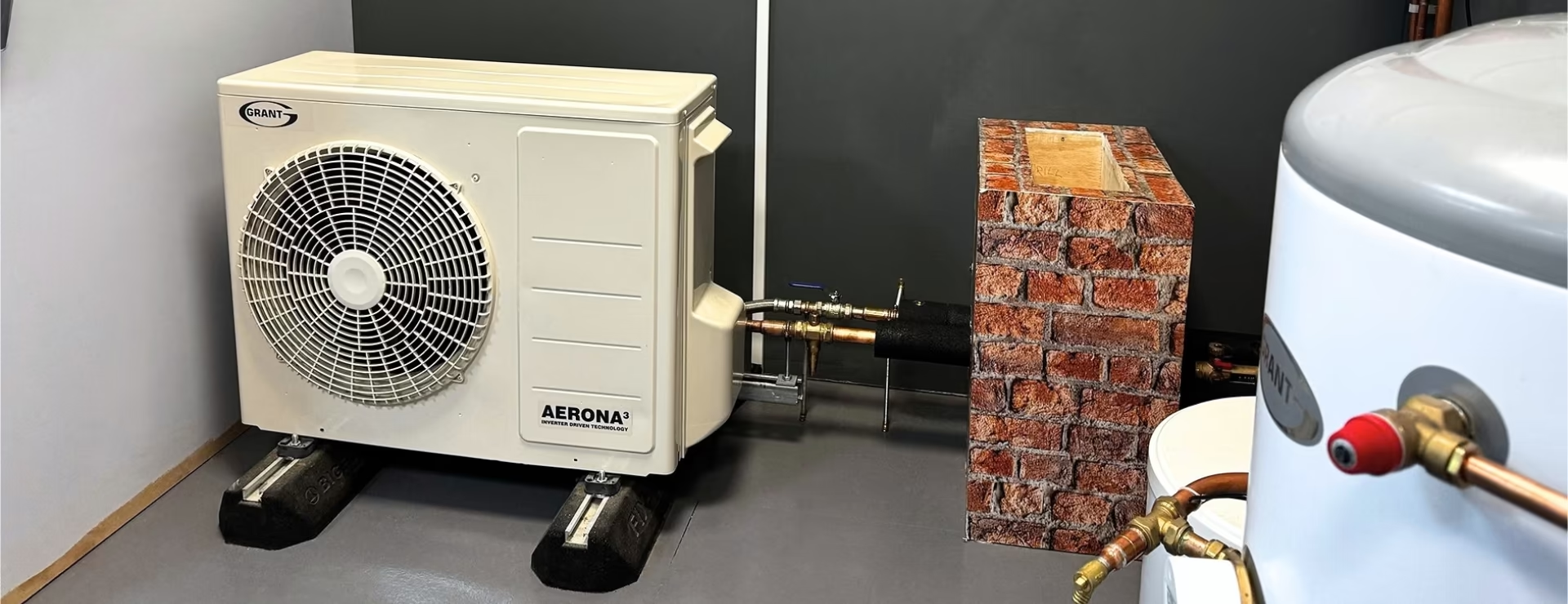
A typical monobloc heat pump arrives with its refrigerant circuit assembled and sealed at the factory. Connecting the water pipework, power and controls without carrying out regulated refrigerant activities does not, by itself, require an F-Gas qualification.
A split system may require refrigerant pipework to be connected on site. Where that involves applicable fluorinated refrigerants, the engineer carrying out the regulated work needs the appropriate F-Gas qualification.
The same boundary applies during maintenance. Checking the heating water circuit is different from recovering refrigerant or repairing refrigerant components. Also, some regulated leak checking requires qualifications even when you do not open the circuit.
Individual qualifications and company certification
Your personal F-Gas qualification is not the same as company certification. Businesses, including sole traders, undertaking relevant work on stationary equipment for others also need the appropriate F-Gas company certification.
Refrigerants also bring different safety requirements. Logic4training provides separate flammable refrigerant training alongside its F-Gas courses. Do not assume one qualification covers every refrigerant or every task.
Explore our F-Gas and refrigeration training if refrigerant work forms part of your planned service. It sits alongside heat pump competence, rather than replacing it.
Which Low Carbon Route Should You Take?
Choose your next qualification around the work you want to deliver. Adding a relevant skill is more useful than collecting qualifications without a clear scope of work.
Before booking, gather your qualification certificates and outline the work you intend to undertake. Include whether you want to design systems, install them, maintain them or handle refrigerants. This helps the training team identify the right course and any gaps.
Build on Your Existing Gas and Heating Skills
Adding low-carbon technology does not have to mean abandoning gas work. You can broaden your services while continuing to work within your existing gas competence and registration.
For many experienced heating installers, low-temperature heating and heat pumps are the most closely related next steps. Refrigerant work adds a separate competence requirement. MCS adds a business certification pathway. Solar PV and batteries belong to an electrical route.
The core journey is straightforward: existing skills, relevant training, technical competence and certification where required. The right combination depends on your starting point and the work you want to take on.
Explore low-carbon heating training, check our F-Gas courses, or review the entry requirements for solar PV and battery storage training. If you are unsure where to start, call Logic4training on 020 8845 7222 with details of your qualifications and experience.
Frequently Asked Questions
Can a gas engineer become a heat pump installer?
Yes. Gas and heating installation experience can provide a useful foundation, but you still need appropriate heat pump and supporting system competence. Check the course entry requirements, including installation experience, water regulations, unvented hot water and low temperature heating qualifications.
Do heat pump installers need F-Gas?
It depends on the refrigerant and activities involved. Regulated work involving fluorinated refrigerants requires the appropriate F-Gas qualification. A typical monobloc installation that leaves the factory-sealed refrigerant circuit untouched does not automatically require it. Relevant businesses may also need company certification.
Is a heat pump course enough for MCS certification?
No. A recognised heat pump qualification can support evidence of technical competence, but MCS certification is a separate business assessment. It includes relevant technical standards, business processes and customer protection requirements. MCS certification is required for Boiler Upgrade Scheme installations.
Can a gas engineer install solar PV?
Gas qualifications alone are not sufficient. Solar PV requires appropriate electrical competence and technology-specific training. A gas engineer who also holds suitable electrical qualifications may be eligible for a specialist course, but an engineer without that foundation needs an electrical training and experience route first.
Can gas engineers train in battery storage?
Yes, provided they meet the electrical entry requirements. Battery storage is an electrical technology, so gas experience alone is not enough. Logic4training’s EESS course is for experienced electrical operatives with the required electrotechnical, Wiring Regulations and initial verification qualifications.


 Your latest offers & alerts