Gas courses for new entrants, registered engineers and commercial installers. Train towards Gas Safe registration, or renew your ACS across domestic, commercial, catering, LPG and metering.
Gas Training Courses
From a domestic CCN1 to renewals and upksill qualifications.
2500+ 
Reviews
Gas Safe
Approved
48
Gas Courses
 new-entrants
 gas
gas
Already Gas Safe registered?
Find ACS renewals, commercial upskilling and specialist categories.
View gas coursesChoose from the relevant type of gas courses

Domestic ACS Gas Safety Courses
ACS renewals and initial assessments for domestic gas engineers, including CCN1, appliances, CMDDA1 carbon monoxide and pipework improver training.
View courses
7 Courses
Commercial ACS Gas Safety Courses (Packages)
Commercial heating and catering gas safety packages for engineers entering commercial work with core, changeover, upskill and new entrant routes.
View courses
5 Courses
Commercial ACS Gas Safety Courses (Modules)
Individual commercial gas modules for experienced installers - direct and indirect fired appliances, boosters, gas engines, pipework and testing and...
View courses
12 Courses
Commercial Catering ACS Gas Safety Training Courses
Commercial catering gas courses for experienced engineers. COMCAT appliance modules, mobile catering LPG, changeover and core catering packages.
View courses
8 Courses
LPG ACS Gas Safety Courses
LPG changeover and category training for engineers holding core gas safety qualifications, such as park homes, boats, vessels, and closed...
View courses
7 Courses
Commercial Laundry Course
Gas training for operatives working on commercial laundry appliances - dryers, washer-dryers and rotary irons on natural gas or LPG.
View course
1 Course
Gas Metering ACS Training Courses
Gas metering ACS training for registered engineers installing, exchanging, removing and commissioning domestic and commercial meters, including CMA1 and MET1.
View courses
6 Courses
Gas Safety Awareness Training Courses
Gas safety awareness and CPD for managers, duty holders, and non-gas trades: social housing, insulation installers, auditing, and equipotential bonding.
View courses
5 Courses
Train on gas. Prove your competence. Stay registered.
At Logic4training, we have been training gas engineers, from first-time entrants to people renewing ACS certificates they have held for decades, since 2002. With over 24 years of experience in optimising our gas courses, we can say you have come to the right place to become qualified in the gas industry.
- ACS assessment across domestic, commercial, catering and LPG
- Routes for new entrants and registered engineers
- Trusted by some of the UK's biggest companies
- Gas training centres in Northolt, Luton, Basildon and Sittingbourne
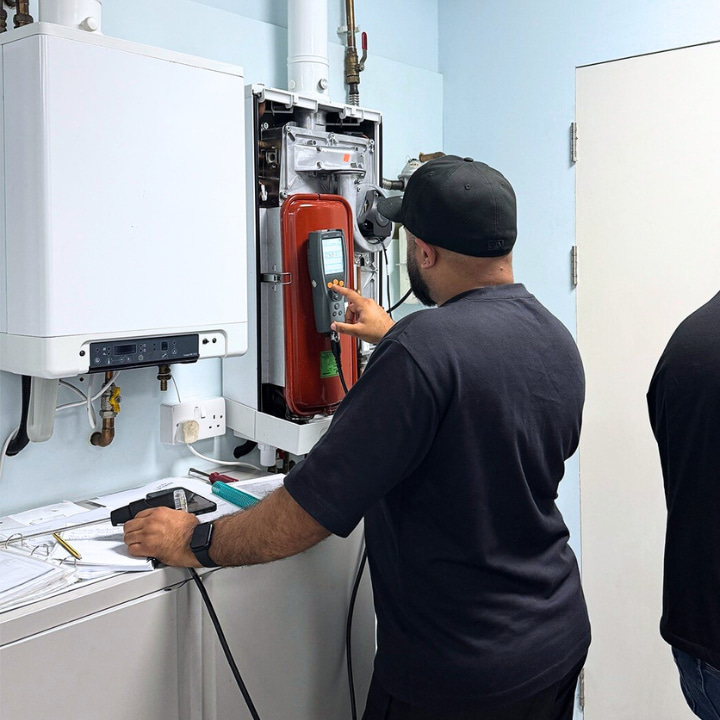
Gas courses explained.
Not sure which gas route is right for you? These quick answers can help you understand your options before you book.
Our gas courses covers eight specialisms, grouped by the kind of work you do.
For domestic engineers, Domestic ACS Gas Safety covers CCN1, boilers, cookers, fires and water heaters. For commercial work, Commercial ACS packages bundle the core and appliance elements together, while Commercial ACS modules let you add or renew single categories.
Beyond that, we cover Commercial Catering for kitchen appliances, LPG for park homes, boats and mobile catering, Commercial Laundry for driers and rotary irons, Gas Metering for meter installation and exchange, and Gas Safety Awareness for non-engineers responsible for premises.
Completely new to gas? Start with our New Entrant Gas Packages instead.
For domestic engineers, Domestic ACS Gas Safety covers CCN1, boilers, cookers, fires and water heaters. For commercial work, Commercial ACS packages bundle the core and appliance elements together, while Commercial ACS modules let you add or renew single categories.
Beyond that, we cover Commercial Catering for kitchen appliances, LPG for park homes, boats and mobile catering, Commercial Laundry for driers and rotary irons, Gas Metering for meter installation and exchange, and Gas Safety Awareness for non-engineers responsible for premises.
Completely new to gas? Start with our New Entrant Gas Packages instead.
It depends which route you need. ACS gas safety courses assume you are already a working gas engineer, while our new entrant packages are built for people starting from scratch.
Domestic, commercial, catering and LPG ACS courses are assessments of existing competence rather than training from the ground up. You need to be Gas Safe registered, or working towards registration through a managed learning programme with on-site experience behind you.
If you are new to the industry, our New Entrant Gas Packages take you from no experience to Gas Safe registration, including the portfolio of on-site work the qualification requires. Gas Safety Awareness courses are the exception, since they are open to anyone responsible for premises and do not require a trade background.
Domestic, commercial, catering and LPG ACS courses are assessments of existing competence rather than training from the ground up. You need to be Gas Safe registered, or working towards registration through a managed learning programme with on-site experience behind you.
If you are new to the industry, our New Entrant Gas Packages take you from no experience to Gas Safe registration, including the portfolio of on-site work the qualification requires. Gas Safety Awareness courses are the exception, since they are open to anyone responsible for premises and do not require a trade background.
Our gas qualifications are awarded by LCL Awards, an Ofqual-regulated awarding organisation, and Logic4training is an approved centre.
The work itself is regulated separately. Anyone carrying out gas work in the UK must be on the Gas Safe Register, which is the official registration body appointed under the Gas Safety (Installation and Use) Regulations 1998 and enforced by the Health and Safety Executive. ACS certificates are what you hold to register and to renew every five years.
Logic4training is also accredited by IGEM, the Institution of Gas Engineers and Managers.
The work itself is regulated separately. Anyone carrying out gas work in the UK must be on the Gas Safe Register, which is the official registration body appointed under the Gas Safety (Installation and Use) Regulations 1998 and enforced by the Health and Safety Executive. ACS certificates are what you hold to register and to renew every five years.
Logic4training is also accredited by IGEM, the Institution of Gas Engineers and Managers.
You need ACS certificates in the categories of work you intend to carry out, and then you apply to the Gas Safe Register yourself. Training comes first, registration second.
If you are new to the trade, our new entrant gas engineer packages take you from no experience through to the gas ACS assessments the Register expects. Engineers returning after a break usually need their domestic ACS certificates reinstating instead.
You cannot register on training alone. The Register checks your certificates and your work, and charges an annual fee to keep you listed.
If you are new to the trade, our new entrant gas engineer packages take you from no experience through to the gas ACS assessments the Register expects. Engineers returning after a break usually need their domestic ACS certificates reinstating instead.
You cannot register on training alone. The Register checks your certificates and your work, and charges an annual fee to keep you listed.
ACS stands for Accredited Certification Scheme. It is the industry standard assessment route for gas engineers in the UK, and holding valid ACS certificates is what allows you to join the Gas Safe Register and work legally on gas appliances.
Certificates are held per category of work rather than as a single qualification. Most domestic engineers hold CCN1 core gas safety plus appliance categories such as cookers, fires and boilers, while commercial engineers hold their own core and appliance modules.
ACS certificates last five years. See our Domestic ACS Gas Safety Courses for initial assessments and renewals, or our Commercial ACS packages for commercial work.
Certificates are held per category of work rather than as a single qualification. Most domestic engineers hold CCN1 core gas safety plus appliance categories such as cookers, fires and boilers, while commercial engineers hold their own core and appliance modules.
ACS certificates last five years. See our Domestic ACS Gas Safety Courses for initial assessments and renewals, or our Commercial ACS packages for commercial work.
ACS is the assessment. Gas Safe is the register. ACS certificates prove you are competent in specific categories of gas work and are gained through an approved centre such as Logic4training. The Gas Safe Register is the official list of businesses and engineers legally permitted to work on gas in the UK.
You need the certificates before you can register, and the two run on different clocks: ACS certificates last five years before reassessment, while Gas Safe registration is renewed annually.
Browse our domestic ACS courses or commercial ACS packages to renew existing certificates or add new categories.
You need the certificates before you can register, and the two run on different clocks: ACS certificates last five years before reassessment, while Gas Safe registration is renewed annually.
Browse our domestic ACS courses or commercial ACS packages to renew existing certificates or add new categories.
Gas training length depends on the route. Individual ACS assessments and appliance categories usually run over one to three days. Renewals are shorter than initial assessments because they test competence you already hold.
New entrant routes are longer, running over several weeks as managed learning programmes that build practical skills before assessment. Exact durations are listed on each course page.
New entrant routes are longer, running over several weeks as managed learning programmes that build practical skills before assessment. Exact durations are listed on each course page.
For experienced engineers, ACS renewals take 4 days. For someone starting from scratch, becoming Gas Safe registered typically takes several months and is heavily depended on how quickly someone can complete their gas portfolio.
ACS reassessments are short because they test competence you already have. A single category might be a day, a full domestic ACS renewal covering core plus appliances usually runs across several days, and commercial packages longer again depending on how many categories you hold.
The new entrant route is different. Our New Entrant Gas Packages combine centre-based training with a portfolio of supervised on-site work, and it is the portfolio that sets the pace, since you need real installations to evidence. How quickly you gather that evidence depends on your access to site work.
Exact durations are listed on each course page, and weekend options are available on selected courses.
ACS reassessments are short because they test competence you already have. A single category might be a day, a full domestic ACS renewal covering core plus appliances usually runs across several days, and commercial packages longer again depending on how many categories you hold.
The new entrant route is different. Our New Entrant Gas Packages combine centre-based training with a portfolio of supervised on-site work, and it is the portfolio that sets the pace, since you need real installations to evidence. How quickly you gather that evidence depends on your access to site work.
Exact durations are listed on each course page, and weekend options are available on selected courses.
Gas Training Courses at Logic4training range from £70 + VAT for shorter courses to £3500 + VAT for our most comprehensive qualifications.
For example, the LPG Training Course For Residential Park Homes starts from £70 + VAT.
Full course packages are also available, which can reduce overall costs. We offer finance and pay-in-instalments options, so speak to our team for current pricing and offers on gas training courses.
For example, the LPG Training Course For Residential Park Homes starts from £70 + VAT.
Full course packages are also available, which can reduce overall costs. We offer finance and pay-in-instalments options, so speak to our team for current pricing and offers on gas training courses.
ACS assessments are competence based, so not passing first time means the assessor has identified a gap rather than a permanent fail. You are told which element was not met and what evidence is needed.
Retakes can normally be arranged, and in many cases only the element you did not pass has to be repeated rather than the whole assessment. speak to our team to check the retake arrangements for the course you are booking.
Retakes can normally be arranged, and in many cases only the element you did not pass has to be repeated rather than the whole assessment. speak to our team to check the retake arrangements for the course you are booking.
Ready to start your gas training?
Not sure whether you need a renewal, an upskill or a route in? Speak to our team and we'll help you choose the best gas course for your experience, goals and next step.


 Your latest offers & alerts