
TL;DR
- What it does: Solar battery storage captures excess energy from your solar panels and holds it for the evening, night‑time or cloudy periods, instead of sending it straight back to the grid.
- Why people add it: It can significantly reduce peak‑rate grid imports, increase solar self‑consumption from roughly 30-40% to around 70-80% in many homes, and offer more control over when and how you use electricity.
- Who it suits best: Homeowners with decent roof space, high evening usage or EV/heat pump loads, and access to smart or off‑peak tariffs tend to see the strongest savings and fastest payback.
- The trade‑offs: Batteries still cost several thousand pounds installed and often take around 8-15 years to pay back, so they are a medium‑ to long‑term investment rather than a quick win.
- Bottom line: For the right UK home, solar plus battery storage can cut bills, boost energy independence and future‑proof against volatile prices; for low‑usage homes on generous export tariffs, panels alone may make more financial sense.
What is solar battery storage?
Solar battery storage is the missing piece that makes solar power work on your schedule, not the sun’s. It captures the electricity your panels generate in the day and holds it ready for the evening, night‑time and dull weather, so you draw far less from the grid and get more value from every unit of solar you generate. For UK homes facing high electricity prices and time‑of‑use tariffs, this shift from “use it or lose it” to “generate, store and use later” is what turns a basic solar PV system into a flexible, smarter energy system.
In simple terms, here’s how it all fits together.
- Solar PV generates direct current (DC) electricity when the sun is out.
- An inverter converts this DC into alternating current (AC) so your home can use it.
- A battery then stores any excess DC energy so you can use it in the evening, at night or during cloudy spells instead of importing from the grid.
Most domestic systems today use lithium‑ion batteries, which offer high efficiency and a compact footprint, with typical usable capacities from around 4-15 kWh for UK homes, depending on property size and demand. You can fit a battery at the same time as your solar panels in a DC‑coupled or hybrid setup for slightly higher efficiency, or add one later as an AC‑coupled retrofit, which is often simpler and cheaper to install on an existing PV system.
How solar batteries work in practice
A modern solar‑plus‑storage system runs quietly in the background, constantly balancing what you generate, what you use, what you store and what you send to the grid. It measures power flows many times a second and automatically chooses the cheapest and most efficient source of electricity, so you simply see lower grid imports and a fuller use of your solar.
Daytime: When the sun is shining
On a bright day, your system will typically follow this order:
- Solar first powers your home’s loads. Your panels produce DC electricity, which the inverter converts to AC and feeds into your appliances and sockets.
- Surplus charges the battery. Any solar you are not using immediately is automatically diverted into the battery, topping it up throughout the day.
- Any extra is exported to the grid. Once the battery is full and your home’s needs are met, remaining solar generation is exported under the Smart Export Guarantee (SEG) or other export tariffs, earning you a payment per kWh.
This all happens without you needing to switch anything on or off. The controls and inverter decide, moment by moment, whether to prioritise the home, the battery or export.
Evening and night: When solar drops
When the sun goes down or clouds roll in, the direction of flow reverses:
- The battery discharges to supply electricity. Stored energy is released back through the inverter to cover your evening and night‑time usage, such as cooking, TV, lighting and device charging.
- When the battery is empty, your supply reverts to the grid. Once the battery reaches its minimum reserve level, the system automatically stops discharging and your home draws power from the grid as normal.
In most homes, this cycle repeats every 24 hours, with the grid acting as a seamless backup when needed.
Time‑of‑use and smart tariffs
With smart time‑of‑use tariffs, solar batteries can do more than just follow the sun; they can also follow prices:
- Off‑peak charging: On tariffs such as Octopus Flux and other smart options, you can set the battery to charge from the grid during cheap off‑peak windows (often overnight), in addition to charging from solar.
- Peak‑time use and export: During peak price periods, the system can prioritise discharging the battery to run your home and, where it makes sense, export some of that stored energy back to the grid at higher rates.
Some advanced tariffs and batteries can even optimise this automatically, turning your home into a small “energy trader” that buys low, uses or sells high, without you having to manage it day to day.
What’s happening behind the scenes?
All of this is coordinated by a small stack of smart hardware and software:
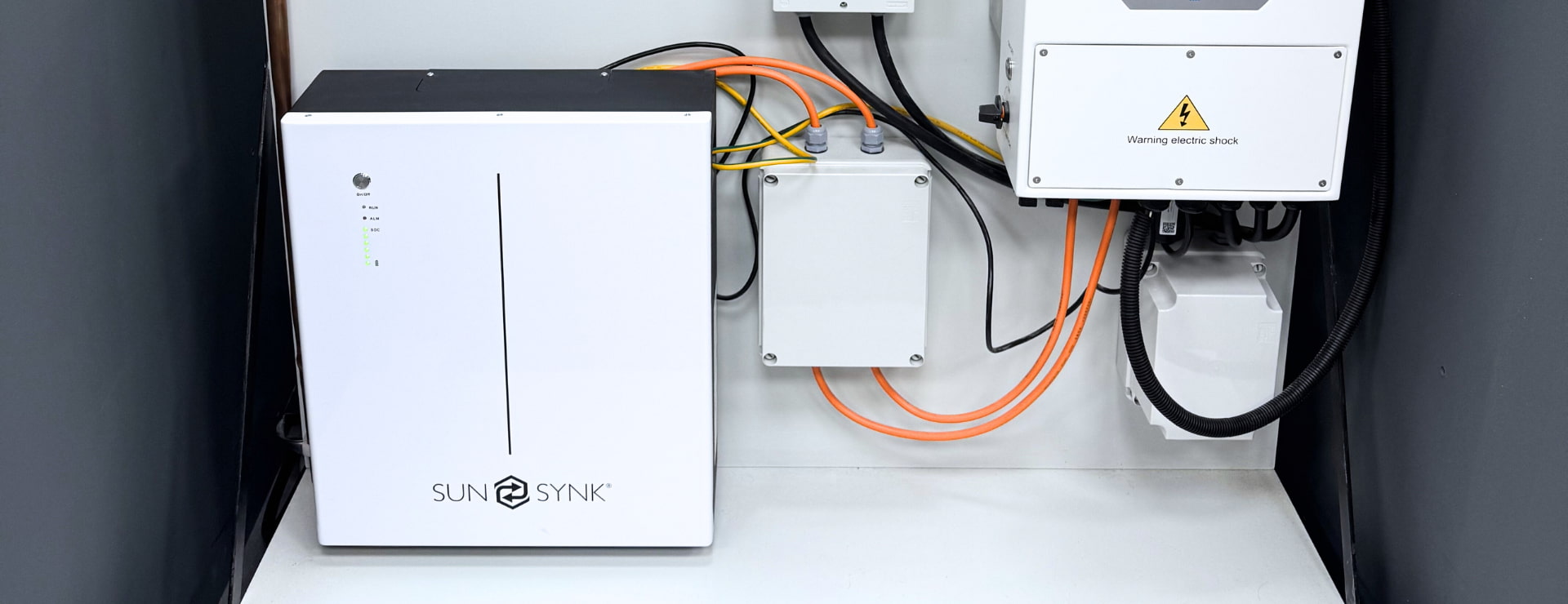
- Hybrid inverter (or PV inverter plus separate battery inverter): Converts DC from panels and battery into usable AC, and controls when to send power to the home, the battery or the grid.
- Battery Management System (BMS): Built into the battery to protect the cells, control charge and discharge rates, and extend battery life.
- Monitoring system or app: Shows real‑time generation, battery state of charge, imports and exports on your phone or web dashboard, and lets you adjust settings like charge windows and backup reserve.
The result for the homeowner is simple: the lights stay on, the app shows where your power is coming from, and the automation quietly works to minimise your bills and maximise your use of clean, self‑generated energy.
Key components of a solar‑plus‑storage system
A complete home solar‑plus‑storage setup is more than just some panels and a battery on the wall. It is a coordinated electrical system that must be designed, installed and commissioned correctly to be safe, efficient and compliant with UK regulations – exactly the kind of whole‑system thinking Logic4training focuses on in its renewables and electrical courses.
In a typical UK home, a system will usually include:
- Solar PV panels (often 3-6 kWp for UK homes)
This is your generation source. A 3-4 kWp array (roughly 8-12 panels on many roofs) can cover a large share of a typical three‑bed home’s annual electricity use, with 5-6 kWp common in higher‑demand or all‑electric homes. Correct sizing, orientation and string layout are covered in depth on installer training, because they directly affect yield, payback and DNO approvals. - Inverter or hybrid inverter
The inverter is the brain and gateway of the system, converting DC from the panels (and, in a hybrid) the battery into AC electricity for the home and grid. Hybrid inverters also manage charging and discharging, enforce export limits and communicate with monitoring platforms. Understanding inverter selection, protection and communication is a core part of professional design and commissioning training. - Battery storage (typically 4-15+ kWh)
The battery is sized to your demand and PV output. Many average‑use homes fall in the 5-10 kWh usable range, while larger or high‑demand properties may justify 12-15+ kWh. At Logic4training, we teach installers how to match capacity to usage profiles, tariffs and export limits so that batteries cycle effectively rather than sitting half‑full or empty. - Consumer unit upgrades and protection devices
A safe system nearly always involves work at the consumer unit, including additional breakers, RCD/RCBO protection, an SPD, and sometimes a dedicated sub‑board. Proper cable sizing, fault protection, earthing and labelling are essential to comply with BS 7671 Wiring Regulations and manufacturer guidance. These are fundamental topics in our electrical renewable courses. - Monitoring and control hardware/software
Most modern systems include CT clamps, data loggers or energy meters and a cloud‑connected app that lets you see generation, consumption, battery state and imports/exports in real time. Installers training with us learn how to set up and explain these tools clearly so customers can get the best from their system, including smart tariff optimisation.
Battery types you’ll see
Battery choice affects performance, payback, space requirements and safety, so it is important to understand how different technologies compare. Knowing the pros and cons of each type makes it easier to design systems that work reliably in real homes, not just on paper.
Lithium‑ion (NMC / LFP)
- High efficiency and compact size
Modern lithium‑ion batteries (including NMC and LiFePO₄ chemistries) typically deliver round‑trip efficiencies around 90-95%, meaning very little energy is lost between charging and discharging. They also offer high energy density, so you get a lot of storage in a relatively small, wall‑mounted unit. - Long life and solid warranties
Many domestic lithium‑ion systems come with 10‑year warranties and 4,000-6,000+ cycle life expectations, which equates to daily cycling over a decade or more if used within specified limits. Correct commissioning, temperature management and depth‑of‑discharge settings are vital to achieving this in the real world. - Flexible control and fast response
Lithium‑ion batteries can charge and discharge quickly, making them well-suited to smart tariffs, EV integration and managing short‑term peaks in demand. That flexibility is one reason they have become the default choice in UK domestic installations.
Lead‑acid (including AGM, gel)
- Older technology, now niche in homes
Lead‑acid batteries were the first common option for off‑grid and early solar setups, but in UK domestic on‑grid applications they are now far less common. - Lower efficiency and shorter life
Typical round‑trip efficiencies are around 70-85%, and usable depth of discharge is much lower than that of lithium‑ion, which reduces the practical storage you can access each day. Cycle life is also shorter, often by a few hundred to a few thousand cycles, so they may need to be replaced several times over the life of a PV system. - Heavier and bulkier
Lead‑acid units are physically larger and heavier for the same kWh storage, which can be a challenge in space‑constrained UK homes or where wall‑mounting is preferred.
Because of these differences, most new UK domestic systems now use lithium‑ion batteries as they offer higher efficiency, better usable capacity, longer life and lower whole‑life cost despite a higher upfront price. Battery choice affects performance, payback, space requirements and safety, so it is important to understand how different technologies compare. Knowing the pros and cons of each type makes it easier to design systems that work reliably in real homes, not just on paper. At Logic4training, we emphasise not only the headline specs, but also how to design, protect and maintain these batteries so that customers achieve the performance and safety implied by the datasheet.
System design: Sizing the battery for a UK home
Sizing a solar battery is one of the most important design decisions you’ll make. Get it right and the system will cycle regularly, cut your grid use and pay its way. Get it wrong, and you can end up with expensive hardware that rarely fills or runs out too quickly when you need it most.
Start with your demand and PV size
Before you even think about kWh, you need a handle on how much electricity you actually use and how much your solar can produce.
Check your annual and daily electricity use using past bills, smart meter data or an online portal. Many UK homes sit in the 3,000-4,500 kWh per year range. As a rule of thumb, a 4 kWp solar system in the UK might generate around 8–12 kWh on a decent day, depending on roof orientation, shading and location, and around 3,000-4,000 kWh per year.
Many UK guides suggest indicative pairings between array size and battery capacity, for example:
- 3 kWp PV: about 7 kWh battery.
- 4 kWp PV: about 9 kWh battery.
- 5 kWp PV: about 12 kWh battery.
These are not hard rules, but they reflect a simple idea: you want a battery large enough to capture most of your excess solar on good days, without being so large that it rarely fills outside of peak summer.
For context, several UK sources suggest:
- A typical three‑bed home using 8-10 kWh per day may suit a 10-12 kWh battery for high self‑sufficiency.
- Smaller flats or low‑use homes might only need 3-5 kWh.
- Large, all‑electric homes or those with EVs may justify 15 kWh+.
Usable vs nominal capacity
Battery datasheets usually quote a nominal capacity (for example, 10 kWh), but you rarely have access to all of it. To protect long‑term health, most lithium‑ion systems limit how far they charge and discharge, so real‑world usable capacity is typically around 85–95% of the stated figure. For an 8 kWh battery, that means you might only be able to use around 6.8–7.6 kWh per full cycle in normal operation.
Some systems also keep a built‑in “backup reserve” for outages or extra cell protection, which further reduces the portion you can use every day. Good manufacturers and installers will make this clear, but it is worth remembering when you compare a quote to your daily usage, because a nominal 10 kWh unit does not automatically give you 10 kWh of usable storage every night.
Power output vs storage capacity
It is also crucial to distinguish between capacity and power:
- Capacity (kWh) is how much energy the battery can store.
- Power (kW) is how quickly it can deliver that energy at any one moment.
For example:
A battery/inverter rated at 5 kW can comfortably run a few appliances at once (lights, TV, fridge, maybe the kettle) but might struggle if you try to run several heavy loads simultaneously.
High‑draw devices such as EV chargers and heat pumps can demand 7 kW or more on their own, so you either need higher power capability or intelligent load management if you expect the battery to support them.
This is why system design is more than just “add more kWh”. A well‑designed battery system balances capacity, power rating and household loads, so that it can meaningfully support your routines without being over‑engineered.
Why installer modelling matters
A competent installer will not guess the size; they will usually:
- Analyse historic consumption data (from smart meters or monitoring).
- Estimate solar output based on your roof, shading and system size.
- Factor in your tariff structure (flat vs smart, export rates, off‑peak windows).
- Model different battery sizes to see how often they cycle and how much grid import they actually replace.
Done properly, this process gives you a battery that fills regularly on good days, empties most nights, and delivers a reasonable payback. Done badly, you can end up with a battery that either sits at 100% for days at a time or empties by early evening, in both cases undermining the economics.
Bringing it all together
In short, good battery sizing starts with your real‑world usage and PV output, then layers on practical details such as usable vs nominal capacity and the power rating needed to support your biggest loads. A right‑sized system will cycle often, support the way you live, and make full use of smart tariffs, whereas an oversized or undersized battery can tie up capital without delivering the savings you expect. Taking the time to get this design step right, ideally with proper monitoring data and a detailed quote, is one of the best ways to future‑proof your solar‑plus‑storage investment.
Costs, savings & payback
Costs and savings are often the make‑or‑break factor when deciding whether to add a battery to a solar PV system. In the UK, prices have become more competitive, while 0% VAT and high electricity costs mean well‑designed systems can now offer realistic payback periods for many households. The flip‑side is that batteries are still a major upfront investment, so understanding the numbers is essential before you commit.
Typical UK battery costs
Solar batteries vary in price depending on capacity, brand, warranty, and whether they are retrofitted onto an existing PV system or installed as part of a new package. As a rough guide to fully installed prices:
Small systems (around 4-5 kWh):
- Typically around £2,500-£4,000 installed.
- Suited to smaller homes, flats or households with modest evening use.
Mid‑range systems (8-10 kWh):
- Often in the region of £4,000-£7,000 installed.
- A common “sweet spot” for three‑bed family homes and medium usage.
Larger systems (12-15+ kWh or premium brands):
- Usually £7,000-£10,000+ installed, sometimes more for top‑end systems such as large Tesla or GivEnergy setups.
- Typically used in big properties, all‑electric homes or where multiple EVs/heat pumps are present.
These figures normally include mounting, wiring, commissioning and integration with your existing consumer unit, with installation labour and extra hardware often adding £800-£1,500 to the bare battery price. Hybrid inverters or additional control equipment can add further cost if not already present.
From 1 February 2024, standalone domestic batteries qualify for 0% VAT across the UK, whether installed with new solar, retrofitted to existing PV or even used as standalone storage for grid charging. This policy is due to run until 31 March 2027, after which VAT is scheduled to move to a reduced 5% rate rather than the old 20%, which significantly improves the value proposition compared with previous years.
How much can you save?
Savings from a battery come from three main effects:
- Using more of your own solar rather than exporting it at a lower rate.
- Avoiding buying electricity from the grid at peak prices.
- Potentially charging cheaply off‑peak and using or exporting at higher rates on smart tariffs.
How much this is worth depends on your usage profile, system size, export rate and tariff. Recent UK analyses suggest that:
- A typical three‑bed home with solar plus battery might see total savings of around £600-£900 per year on electricity, of which the battery itself contributes roughly £100-£300 per year on top of what PV alone would save.
- Well‑matched systems on smart time‑of‑use tariffs can push savings higher, sometimes in the £800-£1,000+ per year range for larger homes and bigger batteries that cycle heavily.
To give a feel for the scale, many 2025-2026 guides quote approximate annual savings in medium‑to‑high usage homes as:
- Around 4-5 kWh battery: roughly £400-£600 per year.
- 8-10 kWh battery: roughly £650-£850 per year.
- 15 kWh+ battery: often £1,000+ per year in favourable scenarios (large usage, good solar yield, smart tariffs).
These are broad estimates; actual results vary with your behaviour, location (solar yield), export rate, and how aggressively you use off‑peak charging. Many households will see savings at the lower end unless they actively optimise their system and tariff.
Payback, lifespan and replacement
Most domestic lithium‑ion batteries are warranted for around 10 years or a given number of cycles (often 4,000-6,000), whichever comes first. In practice, a daily‑cycled system will typically use most of that warranty period over a decade or so, after which the battery will usually still work but with reduced capacity.
Pulling together UK guidance:
- Typical payback ranges of around 5-12 years are widely quoted for well‑designed systems that are used heavily and benefit from 0% VAT.
- Payback tends towards the longer end where:
- Usage is low
- Export tariffs are generous (making exporting attractive), or
- Batteries are oversized and do not cycle fully very often
- Where households have high consumption, smart tariffs and well‑matched sizing, battery payback can fall nearer the 6-8 year mark, especially when combined with solar PV in a single project.
By contrast, solar panels themselves often have lifespans of 25+ years, with many modern systems expected to operate well beyond their initial 20–25‑year performance warranty. This means you should plan on replacing the battery at least once during the life of your PV array if you want to maintain full storage capability.
When you put this together, a solar battery is best seen as a medium‑ to long‑term investment in lower bills and greater energy independence, rather than a quick win. Upfront costs remain significant, but 0% VAT, high electricity prices and smart tariffs have pulled many UK households into a realistic 5-12 year payback window, with the added benefit of more control over when and how you use energy. The key is careful design and tariff choice: size the system to your usage, pair it with an appropriate smart tariff, and you’re much more likely to hit the better end of the savings and payback ranges.
When is a solar battery worth it?
Solar batteries are not a guaranteed win for every household; whether they are “worth it” depends on how you use electricity, what tariffs you can access, and how your solar PV system is set up. The more you can shift expensive grid use into periods when you have stored solar (or cheap off‑peak electricity), the stronger the case becomes.
A battery is more likely to be financially and practically worthwhile if:
- You are out of the home during the day and use most electricity in the evening, so there is plenty of surplus solar to store and plenty of evening demand to use it.
- You have, or plan to have, high electrical loads like EVs or heat pumps, which increase your overall consumption and give the battery more work to do.
- You’re on, or can access, good time‑of‑use or smart tariffs, allowing you to charge cheaply off‑peak and avoid peak rates.
- You want to cut reliance on the grid and smooth price shocks, not just chase the absolute fastest payback, valuing energy independence and bill stability as well as pure ROI.
It may be less compelling if:
- You are at home most of the day and already self‑consume most daytime solar, leaving little surplus to charge a battery.
- You have a generous export tariff that pays close to, or more than, your import rate, meaning exporting can be as profitable as storing.
- Your roof can only support a very small PV system, so you simply do not generate enough surplus energy to justify significant storage capacity.
The Smart Export Guarantee (SEG) remains important in the calculation. If your export rate is significantly lower than your import rate, using stored energy rather than exporting can improve savings, because every stored kWh displaces a more expensive imported kWh. If a supplier offers very high export rates or dynamic export tariffs, maximising export instead may be better, especially if you have limited evening demand or a small battery.
Pros & cons of solar battery storage
| Aspect | When it matters most | What it means in practice | Typical impact on homeowner |
|---|---|---|---|
| Lower bills & higher self‑consumption | Homes with good solar output and high evening or night‑time electricity use. | Surplus daytime solar is stored in the battery and used later, so you import less from the grid and use more of your own generation. | Annual bill reductions, better value from the solar array and improved payback on the overall system. |
| Better use of smart tariffs | Properties on time‑of‑use or smart tariffs with cheap off‑peak and expensive peak periods. | The battery charges when prices are low (solar or off‑peak grid) and discharges when prices are high, arbitraging the unit rate difference. | Lower average unit cost per kWh and the ability to benefit more from advanced tariffs. |
| Energy security & comfort | Areas with volatile prices or occasional outages, or households worried about grid reliability. | Stored energy reduces exposure to price spikes and, with appropriate hardware, can support key loads during power cuts. | Greater peace of mind and more predictable running costs over the medium to long term. |
| Reduced carbon footprint | Households aiming to cut emissions and rely less on fossil‑fuelled grid electricity. | More on‑site renewable energy is used at peak times, when grid electricity is often most carbon‑intensive. | Lower personal carbon emissions and a more sustainable way of running the home. |
| High upfront cost | At the quotation stage, when comparing solar‑only versus solar‑plus‑battery options. | Battery systems often add £3,000-£8,000+ to the project cost, depending on size, brand and installation complexity. | Higher initial investment that needs careful payback calculations and may not suit all budgets. |
| Long payback in some cases | Homes with low usage, strong export tariffs or modest solar capacity. | Savings from the battery can take 8-15 years to offset the upfront cost, especially if the battery is under‑used. | Slower financial return, meaning the decision is as much about independence and comfort as pure ROI. |
| Replacement during PV life | When planning long‑term costs over the 20–25+ year life of the solar array. | Batteries typically last 10-15 years, so at least one replacement is likely while panels are still generating well. | Need to budget for future battery replacement as part of lifetime ownership costs. |
| System complexity | Homes with EVs, heat pumps and multiple smart tariffs or devices. | Getting the best from the system requires good setup, monitoring and sometimes fine‑tuning of apps and schedules. | More moving parts to understand and manage, or a greater need for a knowledgeable installer/maintainer. |
UK regulations, safety & installation standards
Battery storage systems are not just another appliance; they are high‑energy electrical installations that must be designed and fitted to modern UK safety and grid‑connection standards. Recent guidance has tightened expectations around where batteries can go, how they should be protected against fire, and what paperwork and accreditation are needed if they export to the grid. For homeowners, this means choosing a competent installer and asking the right questions; for installers, it means staying up to date with PAS 63100, MCS, G98/G99 and SEG requirements.
Location and fire safety
Recent guidance (such as PAS 63100:2024) and local authority advice emphasise:
- Avoiding locations like bedrooms, small cupboards off escape routes and many lofts.
- Preferring garages, utility rooms, dedicated cupboards or suitably designed external enclosures.
- Ensuring adequate ventilation, fire‑resistant mounting surfaces and safe clearances.
Some councils and advisory bodies now note that lofts are generally no longer considered ideal for battery storage under updated fire‑safety guidance.
Certification and grid interaction
For domestic UK systems:
- Installers should be MCS‑certified where PV is involved, and signed up to schemes like RECC or HIES to protect consumers.
- Systems exporting to the grid must meet DNO requirements and be notified or approved under G98/G99 rules.
- To access SEG export payments, the system must be certified and metered correctly.
Taken together, these rules and standards are there to ensure that small‑scale battery systems are safe for occupants, acceptable to insurers and neighbours, and stable for the wider electricity network.
For homeowners, the practical takeaway is simple. Always use a properly qualified installer who is familiar with PAS 63100, MCS and G98/G99 processes, and do not be afraid to ask how they have allowed for fire safety, grid‑connection paperwork and SEG eligibility in their design.
This is exactly the type of regulatory and compliance detail covered in our training, which focuses on safe, standards‑compliant design and installation.
Installer & trades perspective: Why upskill now?
Demand for skilled solar and battery installers in the UK is rising fast. Record‑breaking small‑scale renewables installations, government net‑zero policy and high energy prices are all pushing homeowners and businesses towards solar PV, battery storage, EV charging and heat pumps – and they need qualified tradespeople to design and install these systems safely. For electricians, gas engineers and heating installers, that makes now a very strong moment to upskill into low‑carbon technologies and build a future‑proof service offering.
From a trades perspective, the opportunity is not just “more work”, but better, higher‑value work that leans on strong technical skills. Domestic solar PV and storage installation typically involves surveying the property, calculating system size and orientation, installing mounting systems, fitting inverters and batteries, upgrading consumer units, and completing full test and certification under BS 7671. Customers increasingly expect installers who understand how solar, batteries, EV chargers and heat pumps fit together as one system, not as isolated bits of kit.
For tradespeople, key skills include:
- System design: Matching PV size, battery capacity and tariff to a customer’s usage and property, so the system cycles well and achieves a realistic payback rather than being oversized or underused.
- Electrical integration: Handling consumer unit upgrades, protection, earthing and bonding in line with BS 7671 and the IET PV Code of Practice, including export limiting, surge protection and discrimination.
- Controls and smart tariffs: Setting up monitoring apps, configuring charge/discharge windows, and integrating with EV chargers and heat pumps so that smart tariffs, SEG and time‑of‑use pricing actually deliver lower bills in real life.
- Compliance: Working within BS 7671, manufacturer instructions and emerging guidance on fire safety and location such as PAS 63100, plus understanding MCS, G98/G99 and SEG, so installations pass DNO, scheme and insurer checks without issues.
At Logic4training, our main goal is to help tradespeople bridge that gap between traditional plumbing, gas, electrical work and modern low‑carbon systems. Our renewable and electrical training pathways cover everything from core electrical competence and BS 7671 through to Level 3 Solar PV and battery storage (EESS) qualifications, giving installers the knowledge, hands‑on practice and recognised credentials that schemes like MCS and Competent Persons Schemes look for. Courses are built around real‑world scenarios such as property surveys, system design exercises, commissioning, fault‑finding and paperwork, rather than just classroom theory, so you leave with skills you can use on site from day one.
If you want to move into this space or add solar, batteries and EV charging to your existing services, you can explore our solar PV installer courses, battery storage/EESS training, EV charge point installation and wider low‑carbon heating and renewable training courses. That way, you can align your skills with where the UK market is heading, and position yourself as a trusted, future‑ready installer.
Summary: Is solar and battery storage right for you?
Solar and battery storage allow UK homes to store excess daytime solar energy for later use, lifting self‑consumption from roughly 30-40% with panels alone to around 70-80% in many cases, and reducing reliance on expensive grid electricity. It works best where there is decent roof space, meaningful evening or night‑time demand (for example EVs, heat pumps or busy family homes), and access to smart or off‑peak tariffs, so the battery can cycle regularly and take advantage of lower‑cost periods.
Upfront costs remain significant, typically £2,500-£8,000+ for a domestic battery depending on size and brand, and realistic payback times often sit in the 8-15‑year range, with at least one battery replacement expected over a solar array’s 25‑year life. That means a battery should be seen as a medium‑ to long‑term investment in lower bills, energy independence and carbon reduction, rather than a quick financial win.
For homeowners, the key steps are to understand your usage, check your tariff options and work with an accredited installer who can model different system sizes and configurations against your real data. For installers and trades, upskilling into solar PV, battery storage and smart controls now offers a strong route into higher‑value, future‑proof work as the UK grid decarbonises and demand for competent low‑carbon specialists grows.
FAQs
How much does a solar battery cost?
Most domestic UK systems cost roughly £2,500-£8,000 installed, depending on capacity, manufacturer and whether it is retrofitted or installed with new solar. Larger or premium systems can cost £10,000 or more.
What size solar battery do I need?
As a rough guide, a 3-4 kWp solar array might pair with a 7-9 kWh battery, and a 5-6 kWp array with 12-14 kWh, but the right size depends on your daily usage and tariff. A good installer will model this using your actual data.
How long do solar batteries last?
Most lithium‑ion solar batteries are warranted for around ten years, often linked to a set number of charge cycles. In practice, many systems may last longer but will gradually lose some capacity over time.
Do I need solar panels to have a home battery?
No, you can install a battery without solar and charge it from the grid, often using cheap off‑peak tariffs, but your savings then depend entirely on tariff differences. Pairing batteries with solar generally gives stronger carbon and independence benefits.
Can I install a solar battery in my loft?
Current UK guidance increasingly advises against loft installations, favouring garages, utility rooms, cupboards or suitable outdoor enclosures that meet fire‑safety and ventilation requirements. Always follow the latest standards and your manufacturer’s instructions.
Do solar batteries work during a power cut?
Standard grid‑tied systems shut down in a power cut for safety, even if you have a battery. To have backup power, you need specific hardware and wiring designed for islanded operation, which must be planned from the outset.
Is there any government help for solar batteries?
As of 2024-2026, domestic solar batteries benefit from 0% VAT when installed and you can earn payments for exported energy through the Smart Export Guarantee, but direct battery grants are limited. Always check the latest schemes before committing.




 Your latest offers & alerts