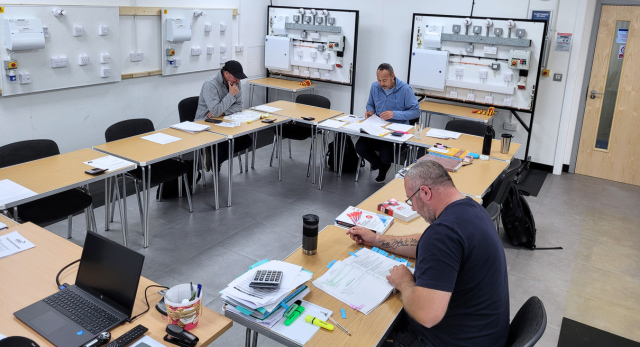

To work as an electrician in the UK, you’ll usually need a mix of technical qualifications and real site experience, typically a Level 2 and Level 3 electrical diploma, the 18th Edition Wiring Regulations qualification and finally a Level 3 electrical NVQ, based on workplace evidence and a final practical assessment such as AM2, which then allows you to apply for the ECS Gold Card to become a qualified electrician. Once you understand this full pathway, it helps to break things down into the core electrical qualifications you’ll actually work through, step by step, on your journey to becoming an electrician.
Core electrical qualifications
If you are looking to become an electrician, it helps to understand the core electrical qualifications you’ll see mentioned again and again:
- Level 2 and Level 3 Electrical Diplomas in Electrical Installations
- The 18th Edition Wiring Regulations qualification
- Level 3 NVQ in Electrical Installations & Maintenance
- The AM2 assessment
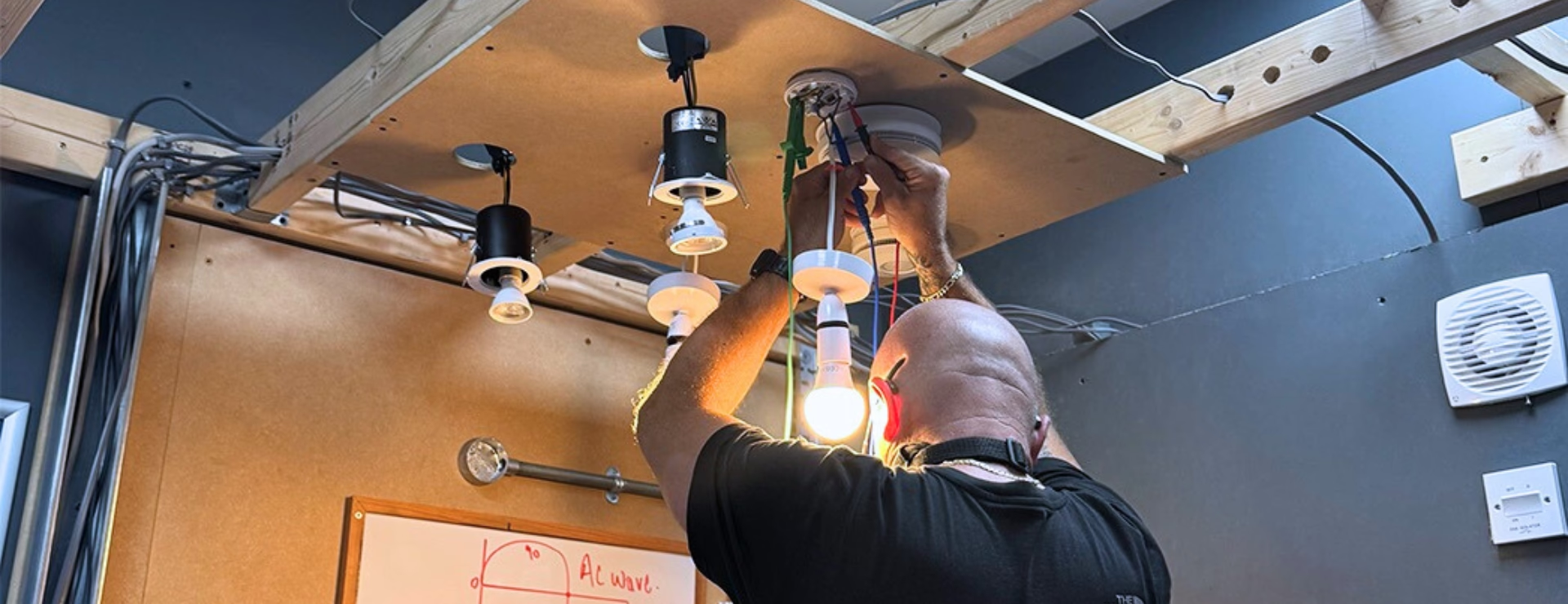
These form the backbone of electrician training in the UK, combining classroom knowledge, hands‑on skills and independent assessment to prove you can work safely and competently on real installations.
1. Level 2 and Level 3 Electrical Diplomas in Electrical Installations
Many new entrants begin their journey with a recognised electrician training course, which provides the foundation knowledge in electrical installation, safety regulations and wiring practices before progressing to advanced qualifications. The Level 2 and Level 3 Electrical Installation Diplomas are usually your first serious step into the trade, giving you the core knowledge and hands‑on skills you’ll build on for the rest of your career. They prepare you for real‑world work and open the door to further training such as the NVQ and, eventually, AM2 and the ECS Gold Card.
These electrical diplomas are a combination of theory and practical sessions that typically cover:
- Electrical principles and how electricity behaves in circuits.
- Safe isolation, earthing and bonding.
- Circuit design, cable selection and protective devices.
- Installation methods for domestic, commercial and light industrial systems.
- Inspection, testing and fault‑finding theory.
Both the level 2 and 3 electrical diplomas are generally completed at a training provider or college.
It is important to note that some training providers offer online versions of these courses, often where the theory elements can be done online and termed as “blended” or “home” learning. Whilst this may seem like a good option, it can lead to a lot of issues when learning. We have going into this in our insight Online Learning vs In-Person Training in the Trades.
2. The 18th Edition Wiring Regulations (BS 7671)
Once you understand the basics of electrical installation, another qualification that you’ll need to gain is the 18th Edition Wiring Regulations. This qualification shows that you can navigate BS 7671 and apply its requirements in day‑to‑day work, from domestic jobs through to more complex installations.
You’ll learn the rules that govern how safe installations are designed and maintained and it’s essential for:
- Working as a competent installer.
- Joining most Competent Person Schemes for domestic work.
- Progressing to inspection and testing roles.
At Logic4training, we deliver the 18th Edition Wiring Regulations training as part of our domestic electrical packages and as a stand‑alone course for those who need to update or refresh.
3. Level 3 NVQ in Electrical Installations & Maintenance
After you’ve completed your classroom‑based diplomas, the Level 3 Electrical NVQ is your chance to prove you can apply that knowledge on real sites, with real customers and real deadlines. It ties your on‑the‑job experience together into a recognised qualification and is a key bridge to both AM2 and the ECS Gold Card.
For the NVQ, you build a portfolio of evidence from genuine site work, covering tasks such as:
- Planning and installing circuits in line with BS 7671.
- Terminating and dressing cables correctly.
- Completing full inspection and testing on new and existing installations.
- Diagnosing faults and rectifying them safely.
- Completing the correct electrical certificates.
NVQ portfolios are reviewed and signed off by qualified assessors, and they are a core requirement for ECS Gold Card applications and JIB grading.
4. AM2 / AM2S / AM2E
The AM2 family of assessments is where everything comes together, testing your practical skills, fault‑finding and paperwork under timed, realistic conditions. It’s designed to give employers and scheme providers independent proof that you can work safely and competently without supervision, which is why it’s so closely linked to Gold Card status.
To put it simply. The AM2 is the traditional end‑point assessment for candidates on NVQ‑style installation and maintenance routes, the AM2S is aligned to the Installation and Maintenance Electrician apprenticeship standard, and the AM2E is designed for experienced workers completing the Experienced Worker Assessment, but all three test the same core skills in safe installation, inspection, testing and fault‑finding.
You’ll be tested on:
- Safe isolation and risk assessment.
- Installing a range of circuits and containment.
- Inspecting, testing and certifying your work.
- Finding and rectifying faults.
Passing an AM2, alongside your NVQ and 18th Edition, is what typically unlocks Gold Card electrician status. Once you hold your ECS card, you canthen consider yourself a qualified electrician in the UK.
Together, these core electrical qualifications take you on a clear journey from learning the fundamentals in the classroom and practical workshops, to proving your skills on site, to passing an independent practical assessment that confirms you can work safely without supervision. By working through each stage in order, you build the recognised portfolio of qualifications that employers, clients and schemes look for when they talk about being a “fully qualified” electrician in the UK.
Do I need GCSEs or a degree?
You don’t legally need GCSEs or a degree to start training as an electrician, but they can make certain routes easier to access. Maths and English GCSEs at grade 4/C or above are often preferred by employers and apprenticeship providers, and many colleges will ask for this level or an equivalent Functional Skills qualification.
A good standard of written and spoken English is also important in day‑to‑day work, because you’ll need to read wiring regulations, complete certificates accurately and communicate clearly with customers and other trades. Even if you already hold a degree in engineering or another field, you will still need to complete the trade‑specific pathway, typically a Level 3 electrotechnical qualification, NVQ Level 3, 18th Edition and AM2, if you want to work as an electrician in the UK.
Logic4training regularly supports learners from non‑traditional backgrounds, including career changers, ex‑forces personnel and those without recent academic experience, helping them build confidence with the theory step by step through structured new‑entrant courses and ongoing learner support.
Skills that help you succeed
Being a good electrician is about more than passing exams or collecting certificates; the way you work, communicate and solve problems will have a big impact on how far you go in the industry. Employers, clients and main contractors all look for people who are not only technically competent, but also reliable, safe and easy to work with on busy, pressurised jobs.
Practical, hands‑on ability is essential, because much of your day will involve using tools, working at height or in tight spaces, and adapting to different environments such as homes, shops, plant rooms and construction sites. Being methodical matters just as much as you’ll need to follow set procedures, record test results accurately and keep paperwork in order so that certificates, reports and job notes all stand up to scrutiny.
Safety‑conscious behaviour underpins everything, from carrying out safe isolation every time, to assessing risks before you start work, to maintaining tidy, well‑organised work areas so others are not put at risk. Strong problem‑solving skills are also vital because much electrical work involves fault‑finding, such as tracing why a circuit keeps tripping, determining the most practical wiring route, and addressing unexpected issues on site without cutting corners.
Good communication rounds this off. You’ll need to explain technical issues in plain English, manage customer expectations, coordinate with other trades and sometimes represent your employer on site, so being clear, polite and professional makes a real difference.
At Logic4training, our mix of in‑centre classroom sessions, workshop practice and realistic scenarios is designed to build these behaviours alongside your technical knowledge, so you leave not just with qualifications, but with the all‑round skills employers are looking for.
How long does it actually take?
When people ask how long it takes to become an electrician, the honest answer is that there’s no single timeline, and it depends on the route you choose, how quickly you pick things up and how fast you can build real on‑site experience. As a rough guide, most adults will spend anywhere from a few intensive weeks on a domestic installer route through to 1-4 years on a full Diploma, NVQ or apprenticeship pathway before they can call themselves fully qualified, so it’s important to choose an option that fits your life rather than chasing unrealistic “quick fixes”.
As a guide:
- Apprenticeship: Usually 3-4 years from starting to Gold Card status.
- Electrical courses: Commonly 1-3 years, assuming you move into employment reasonably quickly and can gather NVQ evidence.
- Domestic installer route: Around 6 weeks for an intensive new‑entrant course, plus additional time for 18th Edition and any scheme‑entry requirements; this is a domestic‑focused route, not full JIB electrician status.
- Experienced Worker Assessment: Roughly 6-18 months, depending on how complete your existing evidence is and how quickly you progress through AM2E.
Anyone promising that you can become a fully qualified Gold Card electrician in just a few weeks is not reflecting current industry expectations.
If you want to learn more about how long it will take to become an electrician, we have covered this topic in our insight How long does it take to become an electrician.
Domestic installer vs fully qualified electrician
Choosing between becoming a domestic installer or a fully qualified electrician comes down to how wide you want your scope of work to be and how much time you’re ready to invest in training. A domestic installer route focuses on getting you working safely in people’s homes as quickly as possible, while the fully qualified electrician pathway takes longer but opens doors to commercial, industrial and more advanced roles across the wider electrotechnical industry.
Below is a breakdown of the 2 occupations.
| Route | Typical training journey | Scope of work | Key points to consider |
|---|---|---|---|
| Domestic installer | Short, intensive training focused on domestic properties (often 4-8 weeks or around 25-30 days), typically including domestic installation, basic inspection & testing and 18th Edition, followed by building experience and joining a Competent Person Scheme for household work. | Single‑phase work in homes only, for example, rewires, consumer unit changes and adding circuits in domestic dwellings. Does not cover full commercial or industrial installations. | Faster and more affordable entry into the domestic market, ideal if you mainly want to work in people’s homes. With new regulation changes to CPS entry requirements, you may need further training later if you want to move into wider electrotechnical roles or apply for an ECS Gold Card. |
| Fully qualified electrician | Longer, structured route normally involving Level 2 and Level 3 Diplomas, site experience, a Level 3 NVQ, 18th Edition and the AM2/AM2E assessment, often completed via apprenticeship or experienced worker pathways over 18 months to 4 years. | Full‑scope work across domestic, commercial and industrial environments, including three‑phase systems, more complex installations, fault‑finding, maintenance and (with additional testing quals) periodic inspection and reporting. | Takes more time and commitment but opens the door to higher‑value contracts, broader job opportunities, site work that requires an ECS Gold Card, and clearer long‑term progression into specialist, supervisory or testing roles. |
How to choose the right route for you
To decide which qualifications you actually need, ask yourself three questions:
- Do I want to work only in people’s homes, or also on commercial and industrial sites?
- Am I starting from scratch, or do I already have several years’ hands‑on experience?
- Do I want full Gold Card status, or a domestic‑only role that fits around another trade or business?
Once you have that clarity, talk it through with a training provider that understands both the qualifications and the realities of the job. Logic4training’s advisors can walk you through domestic routes, full electrotechnical pathways and experienced‑worker options to match your goals, budget and timeframe.
If you’d like to discuss which electrician qualifications you personally need, you can contact Logic4training via the How to become an electrician page or speak to the team directly using the details provided there.
Why train with Logic4training?
Logic4training has been delivering gas, plumbing and electrical training for over 23 years and has trained tens of thousands of tradespeople for roles across the building‑services sector.
Key advantages include:
- Expert trainers with real‑world site experience who understand how the industry actually works.
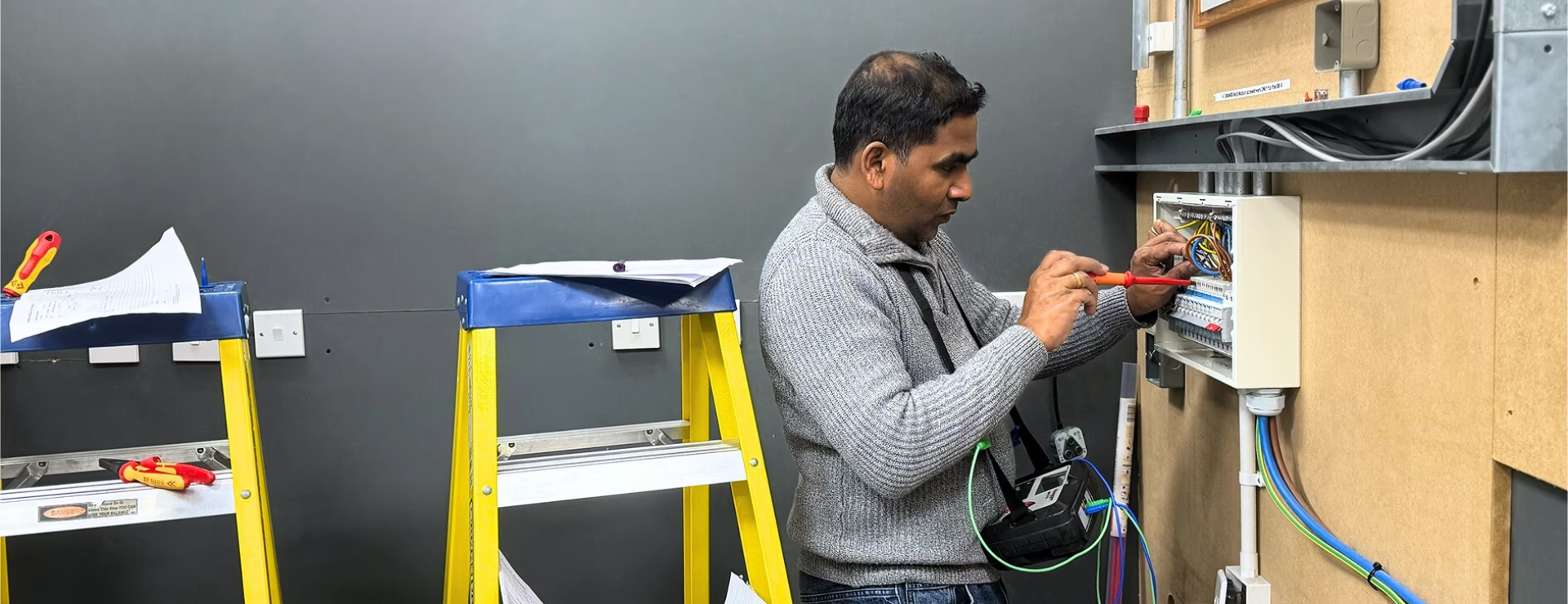
- Modern, well‑equipped centres where you work on real circuits, consumer units and test instruments, not just classroom simulations.
- Small class sizes, giving you plenty of contact time and support.
- Clear progression routes for new entrants, improvers and experienced workers, including domestic, commercial and upskilling options.
Our dedicated How to become an electrician page sets out the packages and typical journeys in detail, so you can see the full picture before you commit
FAQs
Can I become an electrician without GCSEs?
You don’t legally need GCSEs to start training, but Maths and English at grade 4/C or above are often preferred by colleges, apprenticeship providers and employers. If you don’t have them, Functional Skills or other equivalent qualifications can sometimes be used instead, and providers like Logic4training regularly support adult learners who have been out of education for some time.
Do I need a degree to work as an electrician?
No, you don’t need a degree to work as an electrician, and most electricians follow vocational routes rather than university pathways. Even if you already hold a degree in engineering or another subject, you’ll still need to complete the trade‑specific route (typically Level 3 electrotechnical qualification, NVQ Level 3, 18th Edition and AM2) to be recognised as an electrician.
What is the ECS Gold Card and why does it matter?
The ECS Gold Card is an industry‑recognised card that shows you’ve met the standard for an Installation Electrician, including NVQ Level 3, 18th Edition and an AM2/AM2E assessment. Many main contractors, large construction sites and public‑sector projects use it as proof that you’re fully qualified and competent to work unsupervised, so it can make a big difference to your job options and earning potential.
How long does it take to become an electrician?
Timelines vary, but as a rough guide, an apprenticeship normally takes around 3-4 years from starting to Gold Card status, while diploma‑plus‑NVQ routes often take 1-3 years once you’re in work and building your portfolio. Domestic installer pathways are shorter, sometimes around six weeks of intensive training plus extra time for 18th Edition and Competent Person Scheme entry requirements, but these are focused on domestic work and are not the same as being a full ECS Gold Card electrician
Is there a single “electrician qualification”?
There isn’t one single certificate that makes you an electrician; instead, employers and scheme providers look for a bundle of qualifications and evidence. The previously mentioned qualifications, together, underpin the main route to the ECS Gold Card (the industry-recognised proof of qualified status for many employers and construction sites).
For domestic‑only work (for example, working as a Domestic Electrical Installer in people’s homes), there are shorter, focused qualification routes, but you should be clear that this is different from the full “Gold Card electrician” pathway.
Can I become an electrician as a career changer or older learner?
Yes. Many new electricians are career changers entering the trade in their 30s, 40s or beyond, often via flexible training and NVQ routes rather than traditional apprenticeships. Logic4training’s new‑entrant electrician packages are designed specifically with adult learners in mind, combining structured training, step‑by‑step theory and practical support to help you transition into the industry.
Do I have to do an apprenticeship, or are there other routes?
You don’t have to complete an apprenticeship to become qualified; many adults follow a diploma‑plus‑NVQ route with a private provider or college, then complete AM2 to reach the same endpoint. There’s also an Experienced Worker Assessment route for those with 5+ years of on‑site experience but no formal NVQ, leading to AM2E and Gold Card eligibility.
What are AM2, AM2S and AM2E, and which one do I need?
AM2 is the traditional end‑point competency assessment for installation and maintenance electricians on NVQ‑style routes, AM2S is tied to the Level 3 Installation and Maintenance Electrician apprenticeship standard, and AM2E is for those following the Experienced Worker Assessment route. All three cover the same core skills like safe isolation, installation, inspection, testing and fault‑finding but are matched to different training pathways.
Are online‑only electrical courses enough to qualify me?
Short online‑only courses rarely meet industry expectations on their own because they can’t fully test your practical skills, safe working practices and fault‑finding under realistic conditions. Blended learning can work well when online theory is combined with significant in‑centre practical training and assessment, which is why Logic4training focuses on hands‑on workshops and realistic scenarios as a core part of its programmes.


 Your latest offers & alerts