
Need to know what an Electrical Installation Condition Report (EICR) is, if you legally need one, how often it should be done, what those C1/C2/C3/FI codes mean and what a “fair” price looks like? This article explains the Electrical Installation Condition Report from end to end: What’s inspected and tested, how to read the results, typical faults and legal duties for landlords, homeowners and businesses, as well as show electricians how the right training route can turn EICR work into a reliable, future‑proof income stream.
What is an EICR certificate?
An EICR is the written report that follows a detailed inspection and testing of a building’s electrical installation. It records the condition of circuits, consumer units, earthing and accessories, highlighting any damage, wear, non‑compliances or safety risks, and confirms whether the installation is satisfactory or requires remedial work.
The term stands for Electrical Installation Condition Report and is sometimes referred to as a periodic inspection report or landlord electrical safety certificate, especially in the rental sector. Fixed wiring is the focus of an EICR:
- Cables
- Distribution boards
- Sockets
- Switches
- Lighting
- Hard‑wired equipment
Why EICR certificates matter
EICRs are a key part of managing electrical safety, helping duty‑holders identify hidden faults before they lead to electric shock, fire or equipment damage. They give landlords, homeowners, social housing providers and commercial property managers a clear snapshot of risk at a specific point in time, backed by measured test results rather than guesswork.
For landlords in England, Wales and Scotland, periodic EICRs are now a legal requirement, with most private rented properties needing one at least every five years or at the start of a new tenancy. Insurers, mortgage lenders and social housing regulators also increasingly expect a current EICR as evidence that electrical systems are being properly maintained and that risks are under control.
What does an EICR include?
Although formats vary slightly between certification bodies, a compliant EICR will usually include:
- Details of the property and the client: Full address, type of premises (for example, domestic, commercial, industrial), and the name and contact details of the person or organisation ordering the report.
- Details of the person or company carrying out the inspection: Business name, address, contact details, and any registration numbers (for example, NICEIC, NAPIT), plus the inspector’s name and signature.
- Qualifications and competence: A declaration that the person signing is competent to carry out inspection and testing in accordance with the 18th Edition Wiring Regulations, often backed up by scheme membership and internal quality checks.
- Date of inspection and next inspection due: The date(s) the work was carried out, together with a recommended date (or interval) for the next inspection, based on the 18th Edition Wiring Regulations guidance and how the installation is used.
- Purpose, extent and limitations: A clear statement of why the report has been produced (for example, “landlord safety check”, “change of tenancy”, “sale of property”) and exactly what was included, such as “all final circuits in domestic premises including garage and outbuildings”. Any limitations, such as locked rooms, inaccessible voids, or sensitive equipment that could not be isolated, should be recorded so everyone understands what has and has not been assessed.
This top‑level information is vital for landlords, duty‑holders and insurers when they rely on the EICR as evidence of due diligence.
Summary of the installation’s condition
Before you get into pages of test readings, EICRs provide a concise verdict on safety. The “Summary of the installation’s condition” is the headline verdict of the EICR and is usually the first thing a landlord, homeowner or duty‑holder should look at. It gives a simple overall assessment of the installation as either “Satisfactory” or “Unsatisfactory” for continued use, based on the most serious issues found during the inspection and testing. Any report that contains one or more C1, C2 or FI observations will be marked as unsatisfactory, because these codes indicate danger present, potentially dangerous defects, or matters that need further investigation before the installation can be considered safe.
Alongside that headline result, there is usually a short narrative summary that pulls together the main themes from the inspection, for example, highlighting widespread lack of RCD protection, inadequate bonding to services, obvious damage to accessories, or signs of overheating at the consumer unit. This helps non‑technical readers understand, in plain language, why the installation has passed or failed and where the main weaknesses lie. Some EICRs go a step further and flag key risks and suggested actions in this section, separating urgent safety‑critical work from improvements that can be planned over time, so that landlords and facilities managers can prioritise remedial work in a practical, budget‑friendly way.
In effect, this section works like the front page of an MOT. A quick, high‑level view of the installation’s health that you can absorb at a glance before diving into the more detailed schedules of inspections, test results and coded observations that follow.
Schedule of inspections (visual checks)
The schedule of inspections is a systematic tick‑box list covering visual and procedural checks across the installation.
Typical items include:
- Incoming supply and earthing: Condition of service head, meter tails (visual only), earthing arrangement (TN‑C‑S, TN‑S, TT), main earthing conductor size, and adequacy of main protective bonding to gas, water and other services.
- Consumer units and distribution boards: Integrity and construction of enclosures, presence of suitable covers and blanks, IP rating, labelling of circuits, accessibility, presence of appropriate RCD/RCBO protection and evidence of overheating or damage.
- Wiring systems: Type and condition of cables, routing and support, suitability for the environment (for example, outdoors, lofts, bathrooms, agricultural or industrial settings), and signs of deterioration or mechanical damage.
- Switches, sockets and accessories: Condition, secure fixing, correct polarity (inferred from tests), suitability for location (for example, correct IP rating in bathrooms or outdoors) and presence of appropriate shutters or protective devices.
- Special installations and locations: Any areas falling under Part 7 of the 18th Edition Wiring Regulations, such as bathrooms, swimming pools, external lighting, EV charging points or agricultural locations, with additional checks specific to those environments.
Each item is given an outcome such as “satisfactory”, “not applicable”, or coded (C1, C2, C3, FI) where defects are found, ensuring no key aspect of the installation is overlooked.
Schedule of test results (measured values)
Alongside the visual schedule, the schedule of test results captures the measured performance of each circuit.
For every distribution board and circuit, you will usually see:
- Circuit identification and description: Board reference, circuit number, and a clear description (for example, lounge sockets, kitchen ring, lighting on the first floor) to link the test results back to actual areas in the property.
- Protective device details: Type and rating of MCB, RCBO or fuse (for example, B32 MCB), breaking capacity, and whether the circuit has RCD protection, including trip rating and time. This helps confirm that protective devices are correctly sized and suitable.
- Conductor sizes and types: Cross‑sectional area and material of line, neutral and CPC (earth) conductors, plus cable type where relevant, to confirm current‑carrying capacity and compatibility with protective devices.
- Test measurements: Key test values, such as:
- Continuity of protective conductors (R1+R2 or R2).
- Insulation resistance between conductors and between conductors and earth.
- Polarity confirmation.
- Earth fault loop impedance (Zs) at relevant points.
- RCD test results (trip times at 1× and 5× IΔn, functional tests). These values are compared against the 118th Edition Wiring Regulations’ maximums to identify non‑compliances.
- Test limitations and comments: Notes where full testing was not possible (for example, sensitive IT circuits, fixed equipment that could not be disconnected) so that any residual risk is recorded transparently.
For landlords, facilities managers and insurers, this test data shows that the installation has been assessed properly, not just glanced at.
Observations and recommendations (C1, C2, C3, FI)
Every issue found during inspection or testing is listed in an observations section, each with its own classification code.
Each entry will typically show:
- Item number and location: A reference number, plus a clear description of where the defect is (for example, “Oven radial circuit, kitchen”, “Main intake cupboard”, “Bathroom lighting circuit”).
- Description of the defect or non‑compliance: A short explanation linked to 18th Edition Wiring Regulations requirements, such as “No RCD protection provided for socket outlets likely to supply equipment outdoors” or “Main bonding conductor to gas installation pipework undersized”.
- Classification code:
- C1 – Danger present, risk of injury, immediate remedial action required.
- C2 – Potentially dangerous, urgent remedial action required.
- C3 – Improvement recommended (not immediately dangerous but not to current standards).
- FI – Further investigation required without delay where the inspector suspects a problem but cannot fully confirm it within the scope of the inspection.
- Recommended action (often in plain language): Many modern reports add a suggested fix, for example “Upgrade consumer unit to provide 30 mA RCD protection to all final circuits” or “Install main protective bonding conductor to gas meter”.
Best‑practice guidance is clear. Each C1, C2, C3 or FI in the schedules should correspond to a detailed observation, so nothing is hidden in tick boxes alone. Any EICR containing one or more C1, C2 or FI items will be “Unsatisfactory”, while reports with only C3 codes (or no codes at all) are considered “Satisfactory”.
Declarations and signatures
Toward the end of the EICR, you will usually find formal declarations that give the document its weight.
This section normally covers:
-
- Inspector’s declaration: A statement that the inspection and testing have been carried out in accordance with 18th Edition Wiring Regulations and that, in the inspector’s opinion, the installation is either satisfactory or unsatisfactory for continued use.
- Signatures and dates: Signatures (or authenticated electronic sign‑off) from the inspector and, where applicable, a qualified supervisor or verifier within the company.
- Notes on agreed limitations and next steps: Clarification of any agreed restrictions on testing and a reminder that identified remedial works should be completed within appropriate timescales.
For landlords, letting agents and duty‑holders, these signed declarations are what turn pages of technical data into a defensible compliance document.
Putting it all together
When you read an EICR in order, it should tell a clear story: what was inspected, how it was tested, what condition it is in now, and what you need to do next to manage risk. For our candidates and qualified electricians, understanding each part of the report in depth is essential, not just to pass, but to produce EICRs that landlords, social housing providers and commercial clients can rely on when making safety and investment decisions.
How to read and act on an EICR
Once you know what an EICR contains, the next challenge is working out what it is actually telling you and how urgently you need to act. For landlords, homeowners and facilities managers, the key is to treat the report less like a bundle of technical data and more like a structured decision‑making tool: start with the overall result (satisfactory or unsatisfactory), then use the observation codes and comments to prioritise which issues must be tackled now and which can be planned in over time.
A simple way to approach it is:
- Check the overall result: “Satisfactory” or “Unsatisfactory”.
- Look at the observations and their codes (C1, C2, C3, FI).
- Prioritise C1 and C2 remedial work, and arrange any further investigations promptly.
- Use C3 observations as a roadmap for planned upgrades, especially when budgeting or planning refurbishment.
Handled this way, an EICR becomes a roadmap for managing electrical safety rather than something that gathers dust in a file. Keeping copies of past reports and comparing them is a simple but powerful way to see whether your installation is improving, standing still or quietly deteriorating, and it also provides evidence that you have been acting on professional advice when regulators, insurers or future buyers ask questions. From there, the next logical step is to decide whether you actually need an EICR in your situation and how often, which is where the following section on who needs an EICR certificate comes in.
Who needs an EICR certificate?
This section looks at who actually benefits from an EICR in day‑to‑day life, from landlords and letting agents through to homeowners, social landlords and businesses. Understanding where you fit makes it much easier to judge whether an EICR is a legal obligation, a strong recommendation, or simply good practice for peace of mind.
EICRs are relevant to a wide range of people and organisations:
- Private landlords: Most rented homes require a satisfactory EICR at least every five years, or more frequently if the previous report recommends it.
- Letting agents and managing agents: These organisations often coordinate inspections, keep records and track renewal dates on behalf of landlords, using EICRs as part of compliance packs.
- Social housing providers: Guidance for social landlords expects periodic inspection and testing programmes, with EICRs used to prioritise and record remedial works across portfolios.
- Homeowners: While not always a legal requirement, homeowners are strongly advised to obtain an EICR when buying, selling, or if the property is older, has had significant DIY work or shows signs of electrical issues.
- Commercial and industrial occupiers: Offices, factories, shops and public buildings typically follow systematic inspection and testing regimes, often tied to insurance conditions and internal safety policies, with EICRs as the main evidence.
For anyone responsible for a building, an EICR is ultimately about proving that you have taken reasonable steps to keep people safe. Landlords use them to show they meet rental regulations, social housing providers rely on them to manage large portfolios, homeowners use them to uncover hidden risks before they become serious faults, and businesses lean on them to support their duties under health and safety and insurance requirements. Once you know who needs an EICR, the next logical question is how often those checks should happen, which is where inspection intervals and renewal dates come into play.
How often should an EICR be done?
The next step is working out how often those checks should actually take place, and this is where intervals, risk and usage all come together. The 18th Edition Wiring Regulations and associated guidance set recommended periods based on factors like the type of premises, how hard the installation is worked, the quality of maintenance and any issues picked up on the last report, rather than a single “one size fits all” rule
Typical guidance often used in the UK includes:
- Every 5 years for privately rented homes, or at the change of tenancy if recommended sooner.
- Every 5-10 years for owner‑occupied homes, depending on age, condition and any changes to the installation.
- More frequent inspections (for example, 1-5 years) for commercial, industrial and public buildings, especially where there is higher risk, heavy usage or harsh environmental conditions.
The inspecting electrician will always record a recommended date for the next inspection on the EICR itself, and that becomes your anchor point for renewals, unless something significant changes in the meantime, for example, major electrical alterations, a change of use, or obvious signs of deterioration.
Because these intervals are recommendations rather than rigid expiry dates, it’s also important to pair them with competent judgement: using a qualified inspector who understands BS 7671 means your next‑inspection date is realistic for the way your property is actually used, which leads neatly into the question of who is allowed to carry out an EICR in the first place.
EIC vs EICR vs Minor Works: What’s the difference?
These three documents often get mixed up, but they do different jobs.
| Document type | When it’s used | What it proves | Typical user |
|---|---|---|---|
| Electrical Installation Certificate (EIC) | New installation, rewire, new circuit, replacement consumer unit | New work complies with BS 7671 at completion and is safe to energise. | Electricians, contractors, developers |
| Electrical Installation Condition Report (EICR) | Periodic inspection of existing installation (e.g. every 5 years for rentals) | Ongoing condition of wiring, with C1/C2/C3/FI codes and required remedial work. | Landlords, homeowners, facilities managers |
| Minor Electrical Installation Works Certificate (MEIWC) | Small alterations with no new circuit, such as additional sockets or lights | Limited work has been designed, installed and tested correctly on an existing circuit. | Electricians carrying out small jobs |
If you are interested in learning how to carry out inspection and testing and complete these forms properly, our electrical training courses cover certification and reporting as core skills.
Who can carry out an EICR?
An EICR must be carried out by someone who is competent in the inspection and testing of electrical installations, with appropriate qualifications, experience and insurance. In practice, this usually means a qualified electrician who has completed specific training in periodic inspection and testing and works to BS 7671.
Many people look for contractors who are registered with recognised schemes, such as NICEIC, NAPIT or other Competent Person Schemes, as these bodies check qualifications, insurance and sample EICRs for quality. A new Electrical Inspector scheme has even been introduced by NAPIT to tighten standards around who carries out EICRs and to ensure reports are completed competently and consistently.
For electricians who want to move into this area of work, specialist inspection and testing training is essential, because clients are paying not just for a certificate but for competent judgement about risk and compliance. Logic4training delivers a range of electrical training courses for new entrants and experienced installers so that when you price and carry out an EICR, you understand exactly what is involved and can explain the cost to customers with confidence.
Once you appreciate the level of skill, time on site and responsibility behind a good Electrical Installation Condition Report, it becomes easier to understand why prices vary between properties and contractors, which is what we will explore in the next section on how much an EICR costs.
How much does an EICR cost?
Cost is usually one of the first questions people ask about an EICR, and there is a lot of variation in the figures you see online. Prices depend on the size and type of property, the number of circuits, where you are in the country, how complex the installation is and the experience level of the electrician carrying out the work, so it is better to think in terms of realistic ranges rather than a single fixed price.
Many contractors price domestic EICRs based on property size or number of circuits, while commercial and industrial sites often require bespoke quotations after a survey. It is important for clients to understand exactly what is included in the price, for example, whether all circuits are tested, how inaccessible areas are handled, and how remedial work will be quoted if required.
Understanding the price ranges also helps you spot quotes that look suspiciously cheap or unrealistically high, and to budget sensibly for ongoing compliance. Once you know what you are likely to pay, the next step is to look at the kinds of issues that commonly show up on EICRs, because it is often these findings and the remedial work that follows that have the biggest impact on your overall electrical safety spend.
Common issues found on EICRs
When you pay for an EICR, you are essentially paying a qualified electrician to find issues that you cannot see, and certain patterns crop up again and again across homes, rentals and business premises. From worn wiring and tired accessories to missing RCDs, inadequate bonding and overloaded circuits, these common findings are what turn a routine inspection into a genuinely valuable safety exercise, rather than a box‑ticking exercise.
Common observations include:
- Missing or inadequate main bonding to gas and water services.
- Consumer units without RCD protection where required by current standards.
- DIY alterations, undocumented additions and unlabelled circuits.
- Deteriorated accessories, damaged sockets, cracked switches or signs of overheating.
- Use of outdated equipment or wiring methods that do not meet current BS 7671 requirements, even if they were acceptable when installed.
Looking at the faults that appear most frequently on reports also helps to explain why some EICRs come back as “unsatisfactory” and why the remedial bill can sometimes be more significant than the certificate itself. It is these recurring issues, and how they are coded as C1, C2, C3 or FI, that link directly into the legal and regulatory framework behind EICRs, which is what we will explore next to show how condition reports support landlords, social housing providers and businesses in meeting their formal obligations.
Legal and regulatory background
Behind every EICR is a web of regulations and standards that explain why these reports exist and what they need to cover. At the heart of this is the IET 18th Edition Wiring Regulations, which sets the technical benchmark for how electrical installations should be designed, installed, inspected and tested, and the Electricity at Work Regulations 1989, which place a legal duty on employers and duty‑holders to keep electrical systems safe. In the housing sector, this framework is reinforced by specific rules such as the Electrical Safety Standards in the Private Rented Sector (England) Regulations 2020 and emerging requirements for social housing, which make periodic inspection and testing, usually via an EICR, a formal legal expectation rather than a “nice to have”.
Some key points include:
- The Electrical Safety Standards in the Private Rented Sector (England) Regulations place duties on landlords to ensure installations are safe and inspected at least every five years by a qualified person, with written reports provided to tenants.
- BS 7671 (the 18th Edition Wiring Regulations) sets the technical benchmark for design, installation, inspection and testing of electrical systems, and EICRs use its requirements as the reference point for coding observations.
- Other guidance, such as codes of practice for social housing and fire safety, also emphasises regular condition reporting and timely completion of remedial works, especially in higher‑risk settings.
Understanding this legal and regulatory background matters because it turns an EICR from a simple safety check into hard evidence that you are meeting your obligations as a landlord, housing provider, business owner or facilities manager. Failing to comply can lead to enforcement action, fines of up to £30,000 in the rented sector, and serious reputational damage if something goes wrong. For electricians, this context underlines why competent inspection, accurate coding and clear reporting are so important, as well as why training in EICR and condition reporting is essential if you want your reports to stand up to scrutiny from councils, insurers and regulators alike.

Training for EICR and condition reporting
Demand for inspection and testing, and therefore for EICRs, has grown sharply in recent years, driven by tighter landlord legislation, insurer expectations and increased scrutiny from housing regulators, creating a clear skills pathway for electricians who want to specialise in condition reporting and periodic inspection.
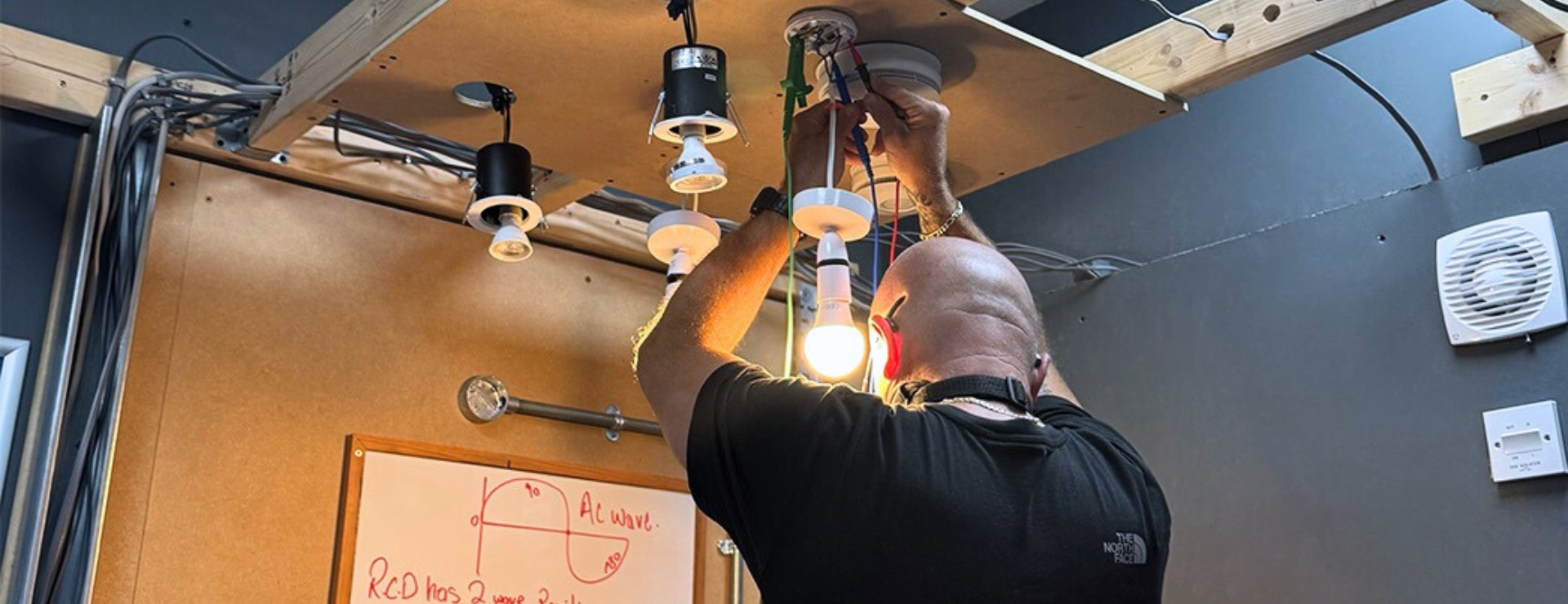
At Logic4training, we turn that demand into a clear skills pathway. Our 18th Edition Wiring Regulations course keeps electricians up‑to‑date with BS 7671, plus dedicated Initial Verification and Periodic Inspection and Testing courses for those signing off installations and EICRs. These LCL Awards Level 3 inspection and testing qualifications are recognised by JIB, ECS and leading schemes. Training centres use purpose‑built rigs that replicate domestic and commercial installations, so learners can practise safe isolation, inspection, testing, fault‑finding and reporting before they enter customers’ properties.
If you are a landlord, agent or duty‑holder, the key message is that not all EICRs are equal. Choosing an electrician who has invested in proper inspection and testing training is as important as booking the check itself. If you are an electrician or aspiring electrician, following a structured route with an experienced training provider, like ourselves, is one of the most effective ways to build a future‑proof career in inspection and testing at a time when demand for EICRs is only increasing.
Summary
Understanding what an EICR is, what it includes and how to act on the findings is central to managing electrical safety in any building. For landlords and housing providers, it is a key compliance document; for homeowners, it is a way to uncover hidden risks; and for businesses, it is evidence that electrical duties are being taken seriously. If your property is due an inspection, the next step is to book an EICR with a qualified, properly trained electrician and be ready to prioritise any C1, C2 or FI items, while planning upgrades flagged as C3. From here, your next step might be to plan remedial works or map out your own training and qualification journey.
FAQs
What do EICR codes C1, C2, C3 and FI mean?
C1 means danger present and requires immediate action, C2 is potentially dangerous and needs urgent remedial work, C3 is an improvement recommendation, and FI means further investigation is required before the installation can be deemed safe.
Does an unsatisfactory EICR mean my electrics are unsafe?
An “Unsatisfactory” result means at least one C1, C2 or FI has been recorded and remedial work or investigation is needed; once these items are resolved and, if appropriate, retested, a new EICR or minor works certificate can confirm compliance.
Can any electrician carry out an EICR?
No. The report should be completed by a competent person with specific inspection and testing qualifications, experience of condition reporting and appropriate insurance, ideally registered with a recognised scheme such as NICEIC or NAPIT.
What’s the difference between an EIC and an EICR?
An Electrical Installation Certificate (EIC) is issued for new work or major alterations, while an EICR assesses the ongoing condition of an existing installation and is used for periodic checks in homes and businesses.
Do I need an EICR to sell my house?
It is not always a legal requirement, but many buyers and their solicitors now ask for an up‑to‑date EICR, especially on older properties, as it provides reassurance on the condition of the electrics and can highlight any major issues before exchange.
How can electricians train to carry out EICRs?
Electricians typically complete 18th Edition training plus Level 3 inspection and testing courses covering initial verification and periodic inspection; Logic4training offers recognised pathways for both new entrants and experienced installers.




 Your latest offers & alerts