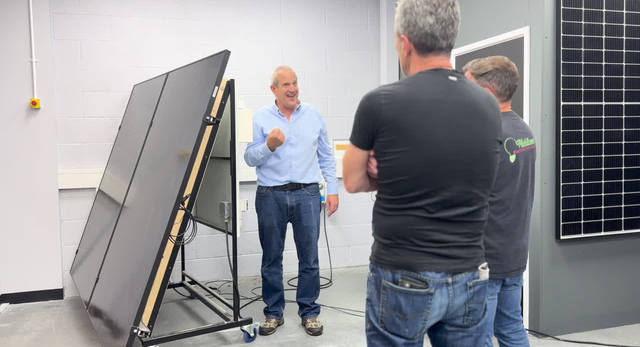

Solar panels convert irradiance into DC electricity, which is consumed by on‑site loads first; any excess is directed, via a hybrid (DC‑coupled) or separate battery inverter (AC‑coupled), into a lithium‑ion storage system, where it is stored as chemical energy and later discharged and converted back to AC to supply the property during periods of low PV output or when time‑of‑use tariffs make grid import more expensive.
TL;DR
- Solar panels turn sunlight into electricity for your home first, then a battery stores any excess for later use.
- An inverter converts the electricity between DC (panels/battery) and AC (your sockets and appliances).
- In the evening, on cloudy days or during power cuts, the battery discharges to power your home instead of importing from the grid.
- Once the battery is full, extra energy can still be exported to the grid via schemes like Smart Export Guarantee (SEG), depending on your tariff.
- Typical UK home batteries are around 5–13.5 kWh, so they can often cover most of a household’s evening demand.
- You can also get “battery‑only” systems that charge from cheaper off‑peak tariffs and discharge when prices are high.
- Solar + battery can cut bills, give some energy independence and reduce your carbon footprint, but payback depends on system cost, usage and tariffs.
- Logic4training trains installers on solar PV, battery storage and wider low‑carbon systems, so this guide is written from an installer and compliance perspective.
How solar panels generate power
Solar panels (solar PV) are built from many small photovoltaic cells, most commonly crystalline silicon, wired together in modules that sit in an aluminium frame under a glass cover. Each cell is a semiconductor device with two differently doped silicon layers forming a p‑n junction, which creates an internal electric field.
When photons of sunlight hit the cell, some are absorbed by the semiconductor and transfer their energy to electrons, freeing them from their atoms. The electric field at the p‑n junction pushes these free electrons in a preferred direction, so they flow through the cell and out into the external circuit as direct current (DC) electricity. Metal contacts on the front and back of each cell collect this current, and when many cells are connected together, the panel produces a useful DC voltage and power output under sunlight.
That DC power then travels via DC cabling down from the roof to your inverter or hybrid inverter, which converts it into alternating current (AC) at the correct voltage and frequency for your home. In grid‑connected systems, the inverter is synchronised with the mains supply and continually monitors how much power the PV array is producing and how much the property is using in real time.
On a typical UK home, the system is designed so your home uses solar power first, directly feeding household loads like lighting, appliances and background “base load”. Any surplus electricity can either be diverted to a battery, if you have one installed, where it is stored for later use, or exported to the grid through your meter so it can be used elsewhere on the network.
Solar generation follows the sun, so output is usually highest around the middle of the day, forming a bell‑shaped curve, while many households see their largest demand peaks in the morning and especially in the evening. This mismatch between when solar produces the most energy and when people actually use the most power is exactly what battery storage is designed to solve, by capturing excess midday generation and shifting it into those higher‑demand periods.
New solar PV technology
Perovskite solar cell technology is an emerging form of PV that uses thin‑film semiconductors with a “perovskite” crystal structure instead of, or in combination with, crystalline silicon, and can be tuned and layered in tandem with silicon to capture more of the solar spectrum and reach higher efficiencies from the same roof area. It works on the same basic principle of turning light into DC electricity but is still moving from lab and pilot lines into early commercial products, so it is more about future‑proofing and higher potential performance than a mainstream choice for UK homes today.
What a solar battery actually does
A solar battery stores surplus electrical energy as chemical energy and then converts it back again so your home can use more of its own solar generation instead of importing from the grid. In most UK homes this is a lithium‑ion battery, similar in chemistry to EV and laptop cells but engineered with robust casings, monitoring and control electronics for fixed, long‑term residential use.
At a high level:
- Solar panels generate DC electricity
During daylight, your PV array converts sunlight into direct current (DC) electricity, which flows through DC cabling to your inverter or hybrid inverter. The inverter constantly measures how much power your home is using and how much the panels are producing, then decides whether to feed loads directly, charge the battery, or export to the grid. - Your home uses what it needs in real time
The system always prioritises on‑site demand, so appliances, lighting and background loads are supplied first from the PV output. This “instant self‑consumption” means part of your daytime usage is already covered before any energy goes to the battery or the grid. - Any spare is routed to the battery and stored as chemical energy
When generation exceeds demand, the surplus is diverted into the battery under the control of the battery management system. Inside each lithium‑ion cell, charging causes lithium ions to move from the cathode to the anode through the electrolyte, storing energy as chemical potential that can later be released. The system monitors voltage, temperature and current so the battery charges efficiently and stays within safe limits. - When solar drops (evening / bad weather), the battery discharges to cover demand
As PV output falls below the property’s demand, the control system switches the battery into discharge mode and DC energy flows back out of the cells. The inverter converts this DC into AC at the correct voltage and frequency, allowing the stored energy to run your normal circuits in the same way as grid electricity, often covering the evening peak and part of the night. - If the battery empties, you fall back on grid power
Once the battery reaches its minimum state‑of‑charge setpoint, the system stops discharging to protect battery life and the home automatically resumes importing from the grid as required. In some setups the battery can also recharge from the grid during cheap off‑peak periods, then discharge during peak‑rate times to provide additional bill savings even when solar generation is low.
By cycling this way, a solar battery can substantially increase self‑consumption of your own PV from perhaps 25-35% without storage to 60-80% or more with storage, depending on system size and usage patterns, which reduces grid imports and can improve resilience where backup capability is included.
Key components in a solar + battery system
A modern solar‑plus‑storage system brings together several coordinated components so that generation, storage and household loads all work in sync. At a minimum, you will see a:
- Solar PV array and mounting system
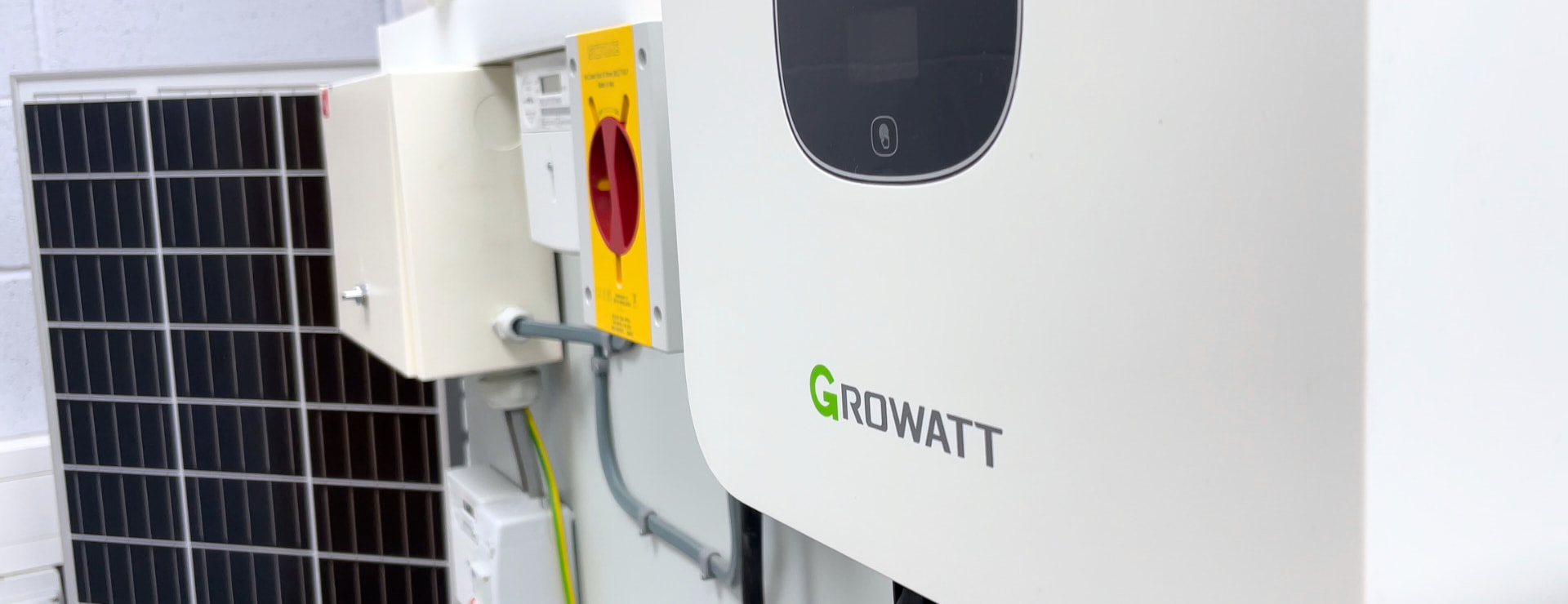
- An inverter or hybrid inverter
- A battery (typically lithium‑ion)
- A battery management system (BMS)
- Associated control electronics
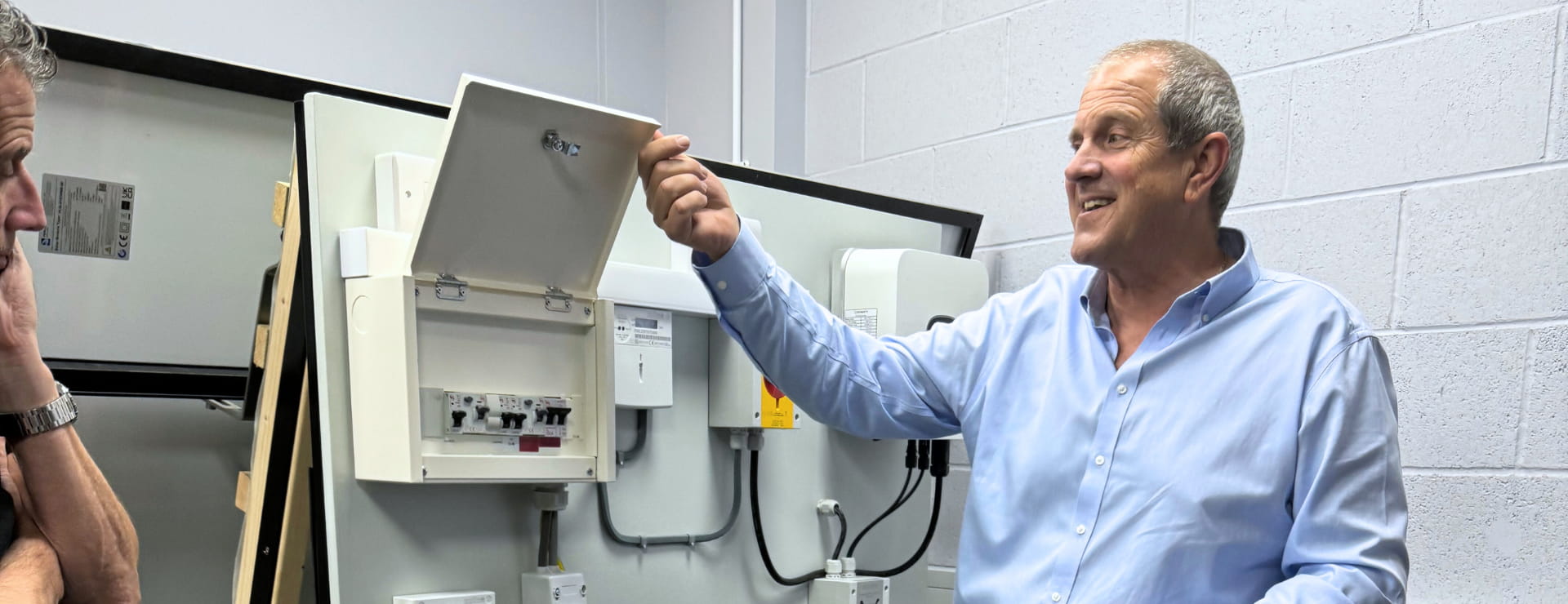
- Consumer unit changes or gateway hardware and protection devices
- Some form of monitoring or smart control via an app or web portal so the homeowner and installer can see what is happening in real time.
These elements form a single energy system rather than a collection of separate boxes, which is why correct design, wiring configuration and commissioning are so important.
Inverter and hybrid inverter
The inverter is the heart of the system from a power perspective, converting DC from the panels and/or battery into AC that can be used by the property or exported to the grid. In a hybrid inverter, this power conversion is bidirectional, so it can take DC from the PV array to supply the house and charge the battery, and also take DC from the battery and convert it back to AC during discharge, often with built‑in export limiting, backup outputs and grid code compliance features.
There are two main connection styles:
- DC‑coupled systems: These place the battery on the DC side of the system. Panels and battery both feed into the hybrid inverter or into a dedicated DC charge controller, so energy is stored before it is converted to AC. Because the electricity only passes through one DC‑AC conversion stage on its way from panel to battery to loads, DC‑coupled systems are usually slightly more efficient, which is why they are common for new installs and where maximising yield really matters.
- AC‑coupled systems: These keep the existing PV inverter in place and add a separate battery inverter/charger on the AC side, connected to the consumer unit. In this setup, PV power is first converted from DC to AC by the solar inverter, and any surplus is then converted back to DC to charge the battery through the battery inverter, before being converted to AC again when discharged, which adds extra conversion steps but makes retrofitting to existing solar much simpler and often more cost‑effective.
The best choice in practice depends on whether PV is already installed, the age and warranty of the existing inverter, available space for equipment, budget, and how you plan to use the system. For example, whether grid‑charging for time‑of‑use tariffs is a priority, or whether backup power to a dedicated critical‑loads board is required.
Lithium‑ion battery pack and BMS
Inside a lithium‑ion battery pack you will find a series of individual cells made up of an anode, cathode, electrolyte, separator and current collectors, arranged electrically in series and parallel to achieve the required system voltage and capacity. During charging, lithium ions move from the cathode to the anode and are stored there; during discharge they move back to the cathode, releasing electrical energy that flows out through the pack terminals as DC. Domestic storage batteries are usually designed as sealed, maintenance‑free units with integrated temperature sensors, contactors and communication interfaces so they can talk to the inverter and monitoring platform.
The battery management system (BMS) is the electronic “brain” of the pack, measuring parameters such as cell voltage, pack voltage, current, temperature, state of charge (SoC) and state of health (SoH), and enforcing safe operating limits. It controls charge and discharge rates, balances cells to keep them at similar voltages, and provides over‑charge, over‑discharge, over‑current, short‑circuit and over‑temperature protection, often disconnecting the battery or signalling the inverter to shut down if anything goes out of range. Without a correctly specified and configured BMS, lithium batteries would be at much higher risk of accelerated degradation or, in extreme cases, thermal runaway, so this is a critical safety and longevity component rather than an optional extra.
Installed correctly by a trained installer, with appropriate fusing, isolation, cable sizing, siting and ventilation in line with manufacturer instructions and industry best‑practice guides, these systems are safe, efficient and require very little day‑to‑day interaction from the homeowner beyond occasionally checking the monitoring app. Logic4training’s electrical and renewables courses cover working safely with DC circuits, inverters, storage systems and associated protection devices in line with current UK standards and guidance, so installers understand both the underlying theory and the practical risk controls needed on site.
Step‑by‑step: how solar and battery work through a typical day
Putting it together, here’s how a system behaves over 24 hours:
Morning
In the morning, as irradiance increases, the solar array begins to generate power and the inverter synchronises with the grid and supplies the property’s base loads such as fridges, standby devices and low‑level heating or hot water controls. At this point, generation may still be close to demand, so little or no energy is stored.
Midday / early afternoon
By midday and early afternoon, the PV system is usually at or near peak output for the day, so generation often exceeds the building’s instantaneous demand. The inverter or hybrid inverter routes this surplus into the battery, raising its state of charge under the control of the battery management system. Once the battery reaches its target maximum state of charge, any further surplus is exported to the grid via the smart meter under the home’s SEG or export arrangement.
Evening
As the sun sets, PV output falls away and eventually becomes lower than the property’s load. At this point, the system transitions to discharge mode and the battery supplies power back through the inverter to cover evening activities such as cooking, lighting, entertainment and, where applicable, EV charging, limited by the battery’s usable capacity and discharge rating. The changeover is automatic, so from the user’s point of view the supply remains seamless.
Overnight
Overnight, if there is still charge available, the battery continues to support the home until either demand drops very low or the battery reaches its minimum state‑of‑charge setpoint. Once that threshold is reached, the system stops discharging to protect battery health and the property automatically imports from the grid instead.
Next morning
The next morning, the cycle starts again as solar generation ramps up and the system returns to supplying loads and, when possible, recharging the battery. With a smart controller or app linked to a time‑of‑use tariff, the homeowner can also schedule the battery to charge from the grid during cheaper off‑peak periods and prioritise discharge during peak price windows, further reducing bills through load‑shifting
Storage capacity, performance and lifespan
Most UK domestic battery systems sit in the 5-13.5 kWh range, with many manufacturers offering modular units so capacity can be increased later if needed. A smaller flat or terraced home with low to moderate electricity use might be well served by a 5-7 kWh battery, whereas larger properties, homes with higher evening demand or households running an EV charger or planning future electrification (like a heat pump) often look at 10–20 kWh or more, typically by stacking two or more battery modules together.
As a rough guide:
- 5 kWh may cover light evening use, such as lighting, electronics, internet equipment and a bit of cooking, particularly in a smaller 1-2 bedroom home or where someone is at home using solar directly in the day. In this scenario the battery is mainly there to smooth out the early evening peak rather than run the whole house all night.
- 10-13.5 kWh may support heavier usage well into the night, especially with efficient appliances and where the household is out during the day, so more of their demand falls in the late afternoon and evening. For a typical 3-4 bedroom UK home this size often strikes a balance: big enough to soak up a good share of surplus solar and cover most evening demand, but not so large that you regularly wake up with a half‑full battery you’ve paid for but rarely use.
Correctly sizing the battery means matching several factors rather than picking a number in isolation. PV system size and typical daily generation should be considered, because a battery that is much larger than the spare solar available will either sit under‑used or rely heavily on grid‑charging, while one that is too small may regularly fill by late morning, leaving additional export that could have been stored.
Household consumption profile (day vs evening) is crucial, so looking at smart meter data or bills to understand how many kWh are actually used between late afternoon and the next morning helps avoid both under‑ and over‑sizing; many UK homes with a 4 kW array find an 8-10 kWh battery is a good match to their typical evening and overnight usage.
Tariffs and whether grid‑charging will be used also influence the “right” size, because on time‑of‑use or dynamic tariffs a slightly larger battery can make sense if you plan to buy cheap off‑peak electricity overnight and use it during peak times, whereas on flat tariffs and high export rates it may be more efficient to keep capacity closer to your genuine solar surplus and evening demand.
Round‑trip efficiency and depth of discharge
When you store energy in a battery and then use it, you lose a bit each time. Most modern lithium‑ion systems have a round‑trip efficiency of roughly 85-95%, so most of what you put in comes back out.
Battery manufacturers typically specify:
- Usable capacity (after keeping a buffer for battery protection).
- Depth of discharge (DoD), also known as how much of the battery can be used regularly.
- Cycle life, also known how many charge/discharge cycles before capacity drops below a warranty threshold.
Many domestic batteries carry warranties of around 10 years, often tied to a maximum energy throughput (MWh) and a remaining capacity figure.
Grid interaction, SEG and tariffs
Solar and battery systems are designed to work alongside the UK grid, not replace it, and the way they interact with tariffs is a big part of whether the numbers stack up. We cover this in detail in our article on solar & battery storage: is it worth it for UK homes & installers?
Key points for UK homes:
- Exporting: If the battery is full and your panels are still generating more than you use, that surplus exports to the grid via your smart meter. Many households earn via Smart Export Guarantee (SEG) or similar export tariffs, so installers need to understand how different suppliers handle SEG eligibility, MCS and DNO paperwork.
- Importing: When PV and battery together cannot meet demand, the system draws from the grid as normal. With a battery‑only system, you may deliberately import during cheap periods to store energy for peak times.
- Time‑of‑use optimisation: On agile or time‑of‑use tariffs, intelligent batteries can charge when prices are low and discharge when prices are high, shaving bills even without large PV arrays. Mark Krull explains how access to the “right” tariff can make or break the business case for storage in his feature on battery storage in solar PV systems – what installers need to know.
- Regulation and metering: Systems must be designed and commissioned in line with DNO requirements, G98/G99 and MCS where applicable, and must be correctly metered to ensure exports are recorded and paid.
Logic4training’s renewables and electrical upskilling courses help installers understand DNO notifications, G98/G99, MCS documentation and how to integrate storage safely into existing installations.
How to decide if solar + battery is right for a home
Installers and homeowners will usually look at a few core questions:
What is the household’s annual and daily electricity use?
- Is usage mainly in the day, evening, or both?
- Is there already PV on the roof, or will it be installed at the same time?
- What electricity tariff(s) are available (standard, time‑of‑use, agile)?
- Is the homeowner more focused on bills, carbon, backup, or independence?
A typical process:
- Gather data – recent bills, smart meter data, occupancy patterns.
- Model scenarios – PV only, PV + small battery, PV + larger battery, battery‑only.
- Consider tariffs – SEG export rate, off‑peak import prices, standing charges.
- Run indicative payback – including realistic assumptions on degradation and tariff changes.
- Check practicalities – roof orientation, space for kit, DNO constraints, consumer unit condition.
Whether solar plus battery is “right” for a home is rarely a simple yes or no. It depends on usage patterns, tariffs, roof potential, budget and what the homeowner values most, from payback to resilience. Installers who can walk customers through these trade‑offs using their own meter data instead of generic promises, and who are honest about where batteries work well and where they may not, are the ones who avoid mis‑selling and build long‑term trust rather than short‑term sales.
Pros and cons of solar battery storage
For installers and specifiers, adding storage also creates an upsell opportunity and helps customers get more from their PV – but it must be designed and explained properly.
A transparent conversation around these points builds trust and helps avoid mis‑selling, an area where Logic4training’s compliance‑focused training is particularly valuable.
Standalone battery storage (without solar)
Standalone battery storage lets a home use a smart tariff to buy electricity cheaply, store it, and then run on that stored energy when prices spike, even if there are no solar panels on the roof. In practice, it turns the battery into a time‑of‑use “buffer” between the property and the grid rather than a store for surplus PV.
A battery system can:
- Charge from the grid during low‑price periods (e.g. overnight).
- Discharge at breakfast and evening peaks when prices are higher.
- Provide limited backup in a power cut if designed for that function.
This approach can suit flats or shaded properties where PV is not viable, but where the homeowner is on a time‑of‑use or dynamic tariff.
From an installer’s perspective, the design considerations are similar to solar‑plus‑storage but with the grid as the only charging source. The maximum charge and discharge rate needs to be sized against the property’s main loads so that, for example, key appliances and a car charger do not frequently exceed the inverter’s output or cause nuisance tripping. Consumer unit configuration, RCD selection and overall protection still need careful thought, especially where a dedicated backup board is provided, and installations should follow emerging standards and best‑practice guidance such as domestic battery best practice publications and PAS 63100, including clearances, fire detection and preferred locations away from main escape routes and direct heat sources.
Logic4training’s electrical training programmes support electricians who want to move into this area, ensuring they understand both on‑site safety and customer communication around benefits and limitations.
Safety, installation and training
Battery installations deal with high energy density and potentially high fault currents, so they must be designed, installed and commissioned by competent, trained people.
Key safety considerations from industry guidance include:
- Choosing a suitable indoor or outdoor location based on manufacturer data (temperature range, IP rating, ventilation requirements).
- Ensuring adequate access for maintenance and emergency services.
- Correctly sizing protective devices and cabling for DC and AC sides.
- Managing fire and thermal runaway risk through correct siting, clearances, and adherence to manufacturer installation instructions.
- Completing DNO notification/approval and commissioning documentation.
Logic4training brings years of experience in electrical, gas and renewables training, giving installers a route to gain the knowledge and practical skills to handle solar PV, storage and wider low‑carbon technologies safely and in compliance with UK standards. This combination of hands‑on training and up‑to‑date technical content is what underpins Logic4training’s authority in the sector.
If you are looking to add solar or battery installation to your services, our renewables and electrical courses are a good starting point, alongside any existing NICEIC, NAPIT or MCS requirements you work under.
FAQs
Do I need a battery for solar panels to work?
No. Solar panels work perfectly well without a battery; the system will power your home first and export any surplus to the grid. A battery simply allows you to store more of that surplus for later use.
Can a solar battery power my home in a power cut?
Only if the system is specifically designed with backup or islanding capability. Standard grid‑tied PV systems without backup shut down during an outage for safety, even if the sun is shining.
How long does a home solar battery last?
Most domestic lithium‑ion batteries come with warranties of around 10 years and are designed for thousands of charge/discharge cycles. Actual lifespan depends on usage patterns, temperature and maintenance.
Is solar battery storage worth it in the UK?
It can be, especially for homes with higher evening usage, good PV output and access to suitable tariffs, but payback varies. A proper assessment of usage, tariffs and system cost is essential before deciding.
Can I add a battery to my existing solar panels?
Yes. Many households retrofit an AC‑coupled battery to an existing PV system. An installer will survey your system, check DNO and metering arrangements, and advise on the right size and configuration.



 Your latest offers & alerts