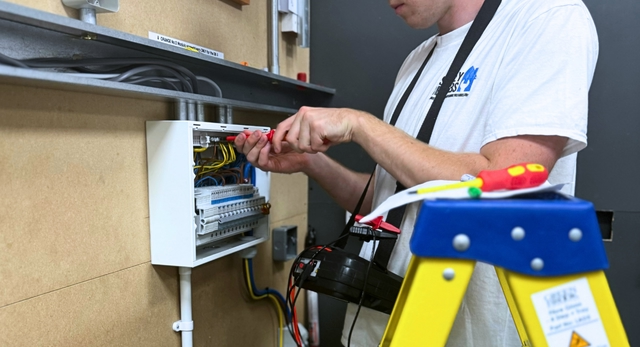

Electricians are already in high demand across the UK and that demand is set to grow further as we try to fix the skills shortage, build more homes and hit net zero targets. For anyone thinking about joining the trade, the shortage is a real problem for the country, but a genuine opportunity for you.
TL;DR:
- Are electricians in demand? Yes. Electricians and electrical fitters are officially classed as “elevated demand” roles, with electrical supervisors in critical demand across the UK labour market.
- Demand is rising faster than supply due to an ageing workforce, fewer apprentices and increasing workloads in housing, infrastructure and building services.
- Net zero and electrification are huge long‑term drivers: the Government’s Clean Energy Jobs Plan names electricians as a priority occupation needed to hit 2030 clean power targets.
- The UK will need around 1.3 million new tradespeople and 350,000 apprentices by 2033, including roughly 111,000 new electricians and 51,000 electrical apprentices.
- This shortage is already affecting real projects, but for new entrants it means strong job security, better earning potential and room to specialise in areas like EV charging, solar PV and battery storage.
- Becoming an electrician is “future‑proof” work: it is hands‑on, problem‑solving, difficult to automate and central to delivering smart homes and low‑carbon technology.
Are Electricians in Demand in the UK?
Yes. Electricians are firmly on the UK’s “in demand” list and are expected to stay there for years. Government labour market analysis for 2025 classifies “skilled metal, electrical and electronic trades supervisors” as being in critical demand, while “electricians and electrical fitters” and “electrical service and maintenance mechanics and repairers” are all in elevated demand across the UK labour market.
In practice, that means:
- Demand already exceeds supply in many areas of the UK.
- The shortage is national, not just a London or South East issue.
- Demand is projected to increase further towards 2030, especially in clean energy and housing.
Electricians are also one of 31 “priority occupations” highlighted in the Government’s Clean Energy Jobs Plan, which sets out how the UK will grow its clean energy workforce by 2030. This puts electricians right at the heart of the country’s long‑term economic and environmental plans.
Why Are Electricians in High Demand?
1. The UK skills shortage is getting worse
The UK is in the middle of a wider skills shortage, but the electrical trade is under particular pressure. The building services sector, which includes electrical, is already struggling to find enough qualified people, with employers reporting real difficulty recruiting for technical roles. At the same time, many experienced tradespeople are nearing retirement while not enough new entrants are coming through to replace them.
Several trends are feeding into this:
- An ageing workforce: the average age of UK tradespeople is now over 50, meaning thousands of experienced electricians are due to retire over the next decade.
- Fewer apprentices: industry analysis shows a decline in electrical apprenticeship starts at exactly the time demand is rising.
- A “live and growing threat”: the Electrical Contractors’ Association (ECA) has warned that the electrical skills gap is no longer a future risk but a current threat to the UK’s plans for electrification and net zero.
At Logic4training, we have seen this firsthand through the employers and learners we work with on gas, plumbing, electrical and renewables training. Employers who work with us often report that their prior vacancies remain open for months because they cannot find suitably qualified electricians for domestic, commercial, and renewable energy roles.
2. Electrification and net zero targets
The UK’s push towards clean energy is one of the biggest long‑term drivers of demand. The Government’s Clean Energy Jobs Plan identifies electricians and electrical fitters as a priority occupation needed to reach its 2030 clean power targets. Across clean energy, jobs are forecast to grow from around 440,000 in 2023 to roughly 860,000 by 2030.
Growth areas for electricians include EV charge point installation for homes, workplaces and public sites, solar PV and battery storage systems in domestic, commercial and industrial settings, and other low‑carbon heating systems that require advanced electrical skills.
Crucially, this is not just policy on paper. Research from Checkatrade’s Trade Nation report shows that 69% of electricians expect the growth of renewable energy and home decarbonisation to drive business growth, and 86% of electricians already working in renewables say they have a positive outlook for their business. In other words, electricians themselves can see the opportunity that net zero creates.
3. Construction, housing and infrastructure growth
On top of net zero, the UK has big housing and infrastructure ambitions. The UK Trade Skills Index 2024 suggests the UK will need around 1.3 million new skilled tradespeople, plus 350,000 apprentices, by 2033 to meet building and energy targets. Electricians make up a significant share of that need.
The report breaks down the forecast for particular trades:
- Electricians: around 111,000 total new recruits, including 51,000 apprentices over the next decade.
- Plumbers: around 90,000 total new recruits, including 42,000 apprentices.
Every new home, commercial building, retrofit project and infrastructure scheme needs safe, compliant electrical work. As housebuilding and refurbishment programmes scale up, the need for qualified electricians only grows.
4. Technology is increasing demand, not replacing it
There is a lot of noise about AI and automation replacing jobs, but skilled trades are some of the least automatable parts of the labour market. Electrical work is physical, variable and problem‑solving based, relying on judgement on site rather than repeatable, predictable tasks. That makes it far harder to automate than, say, routine office work.
At the same time, technology is making electrical work more complex, not less necessary. Smart homes and connected devices need careful design, installation and integration. Electric vehicles, home batteries and solar PV systems must be installed and commissioned by competent electricians, and modern installations require detailed knowledge of regulations, inspection and testing, often with integration into digital control systems.
We explore this in more detail in our guide on why tradespeople are safe from AI, but the key point is simple: smarter buildings and systems mean more work for well‑trained electricians, not less.
Is There a Shortage of Electricians in the UK?
It helps to separate two ideas:
- Demand (how much work is out there)
- Shortage (whether there are enough people to do it).
At the moment, both are true. Demand is high, and there is a genuine shortage of qualified electricians in many parts of the UK.
Analysis of the UK skills shortage shows:
- Demand outpacing supply: Employers across regions report difficulties recruiting electricians fast enough to meet workload, particularly in building services and clean energy.
- A widening skills gap: The ECA describes the electrical skills gap as a “live and growing threat” to the UK’s electrification plans, with apprenticeship starts falling and too few people qualifying at the level the industry needs.
- Broken pipeline: Fewer than one in five learners on some classroom‑based electrical routes progress into an apprenticeship, leaving a gap between initial training and fully qualified status.
At Logic4training, we recognise this concern around the skills pipeline. Our response has been to design electrical training that is genuinely job‑focused, highly practical and supported by strong employer links, so that learners are more likely to move into real work and, where relevant, apprenticeships.
Causes and impacts at a glance
For someone considering training, this combination of high demand and limited supply is exactly what you want to see. Plenty of work, long‑term need and less competition than in many oversubscribed careers.

What Does This Mean for New Electricians?
Strong job security and long‑term demand
Because demand for electricians is tied to national policy on net zero, housing and infrastructure, it is not simply a short‑term boom. The Clean Energy Jobs Plan and associated policies set targets that run to 2030 and beyond, requiring a sustained increase in the number of electricians and electrical fitters in the workforce. Combined with the age profile of the current workforce, this creates long‑term job security for those who train now.
Logic4training has been training building services professionals for over 20 years, and we have seen electrical roles steadily move up the agenda with employers, recruiters and government alike. Learners who complete our electrical courses typically move into roles that offer stable earnings, clear progression routes and the option to work employed, self‑employed or as a specialist contractor.
Opportunities to specialise and upskill
Electricians are well‑placed to move into higher‑value specialisms as their careers develop. Growth areas include:
- Solar PV and battery storage installation for homes and commercial buildings.
- EV charge point installation and maintenance.
- Inspection & testing for landlords, businesses and housing providers.
- Commercial and industrial installation work on larger, more complex sites.
We cover some of the qualification routes for these areas in resources such as our articles on what qualifications you need to be a:
They cover how domestic electricians can upskill into renewables‑focused roles. These specialisms often attract higher day rates or salaries, particularly where there is additional responsibility for design, testing or supervisory work.
A career that can’t be easily automated
As mentioned earlier, electrical work involves a mix of fault‑finding, safety‑critical decision‑making and hands‑on tasks in real‑world environments. That kind of work is difficult to automate, even as AI advances, because every job is slightly different and often requires on‑the‑spot judgment. While software can help with design calculations, documentation or quoting, it cannot replace a qualified electrician working safely on a live installation.
For people asking, “Is being an electrician a good job?”, the resistance to automation is a big part of the answer. It means your skills should stay relevant for decades, with opportunities to retrain and upskill as technology evolves, and you are less exposed to the kind of job displacement we see in many purely desk‑based roles.
There is also lasting value in your practical, human judgment that cannot be replicated by an algorithm. You can read more about this in our articles:
- AI job losses and why tradespeople are safe from AI
- What Jobs Will AI Replace?
- AI in the Trades Survey
- The Rise of AI: Should You Rethink Going to University?
How to Take Advantage of the Demand
If you want to take advantage of the current skills shortage, the key is to follow a recognised qualification pathway that employers trust. In most cases, that means a combination of classroom and workshop training, on‑site experience and final assessment.
Typical qualification pathway
A standard route towards becoming a fully qualified electrician includes:
- Level 2 and Level 3 electrical diplomas, which build your foundation in wiring regulations, installation practice and safety.
- On‑site experience, often through employment or an apprenticeship, where you collect real job evidence.
- Gain your 18th Edition Wiring Regulations qaulification.
- An NVQ Level 3 in Electrotechnical Installation or Maintenance, which proves your competence in the workplace.
- The AM2 assessment, a practical and theory test that acts as a final sign‑off for many electricians.
- ECS Gold Card application.
We break this down in detail in our guides to what qualifications you need to be an electrician, including how different routes suit different starting points.
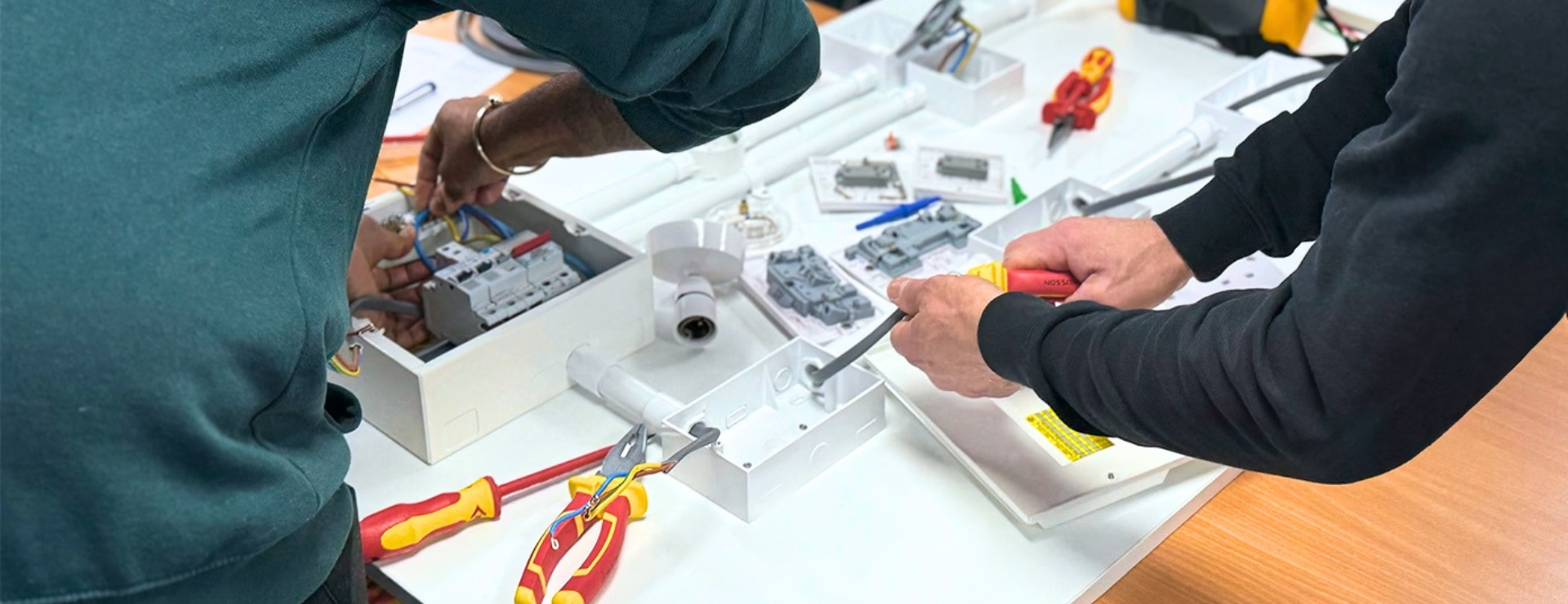
At Logic4training, we offer new entrant electrical programmes that combine classroom learning, extensive hands‑on training in realistic workshop environments and structured support towards recognised qualifications. Many learners are career changers, while others are at the start of their working life, and we tailor advice to both groups.
Logic4training’s role and outcomes
The ECA has criticised parts of the current system for having a “broken skills pipeline”, arguing that some purely classroom‑based electrical courses do not lead to real‑world employment or apprenticeships. We agree that training has to be measured by outcomes, not just certificates, which is why we focus heavily on:
- High‑quality practical facilities that mirror real installations.
- Experienced trainers with industry backgrounds, including electricians who have worked across domestic, commercial and renewables projects.
- Links to employers and ongoing employment support, including CV help, interview preparation and signposting to opportunities.
Our own data shows that a strong proportion of Logic4training’s electrical graduates move into employment or further progression, and many of our case studies feature learners who have retrained and gone on to roles in domestic electrical work, EV charging or solar projects. You can explore this further in our piece on retraining as an electrician in 2026, which sets out real learner stories alongside the qualification routes.
Conclusion
The shortage of electricians is no longer a “future concern” parked for the next generation. It is a live issue that is already affecting housing delivery, infrastructure projects and the UK’s ability to meet its clean power targets. For people considering their options, that shortage translates into strong demand, long‑term job security and the chance to specialise in some of the most important parts of the modern economy.
If you want a career that mixes practical work with real responsibility, offers a clear progression route and is backed by government demand and employer need, becoming an electrician in 2026 and beyond is a very strong choice. Our role is to help you move from interest to qualified status with training that employers recognise and a support network that continues after you pass your exams.
FAQs
Are electricians in demand in the UK?
Yes. Government labour market data and industry reports all show that electricians and electrical fitters are in elevated demand, with supervisors in critical demand across the UK labour market. They are also classed as a priority occupation in the Government’s Clean Energy Jobs Plan and are central to plans for housing and net zero.
Why is there a shortage of electricians?
There is a shortage because demand is rising faster than the number of new electricians entering the trade. An ageing workforce, declining apprenticeship numbers and the rapid growth of clean energy, refurbishment and smart technology have combined to create a gap between the work available and the number of qualified people.
Will electricians still be in demand in the future?
Everything points to “yes”. Clean energy and building targets run to at least 2030, with forecasts suggesting hundreds of thousands of additional clean energy jobs and specific increases in electrical roles. At the same time, the existing workforce is ageing, which means replacements will be needed for years to come even before you factor in new projects.
Is becoming an electrician worth it?
For many people, yes. Being an electrician offers strong job security, opportunities to specialise in areas like renewables or inspection & testing, and the flexibility to work employed or self‑employed. It is also a career that is hard to automate and is aligned with long‑term national priorities, which gives it resilience that many other jobs do not have



 Your latest offers & alerts