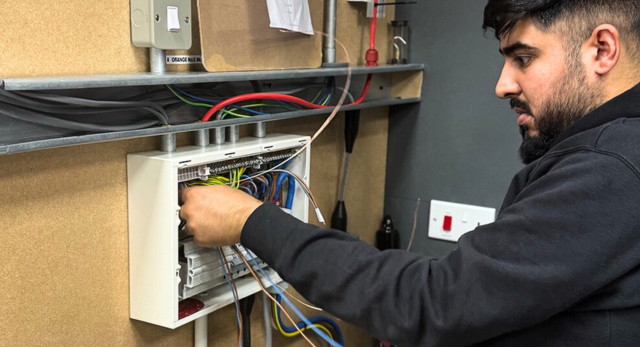

The AM2 assessment is the final, practical sign‑off that proves you are ready to work as a qualified electrician. It brings together everything you’ve learned on site and in the classroom, testing your ability to install, test and fault‑find safely to industry standards in a realistic assessment bay. This article explains exactly what the AM2 involves, who needs to take it, how the different AM2 versions work and how our experience within the industry can help you prepare for your AM2.
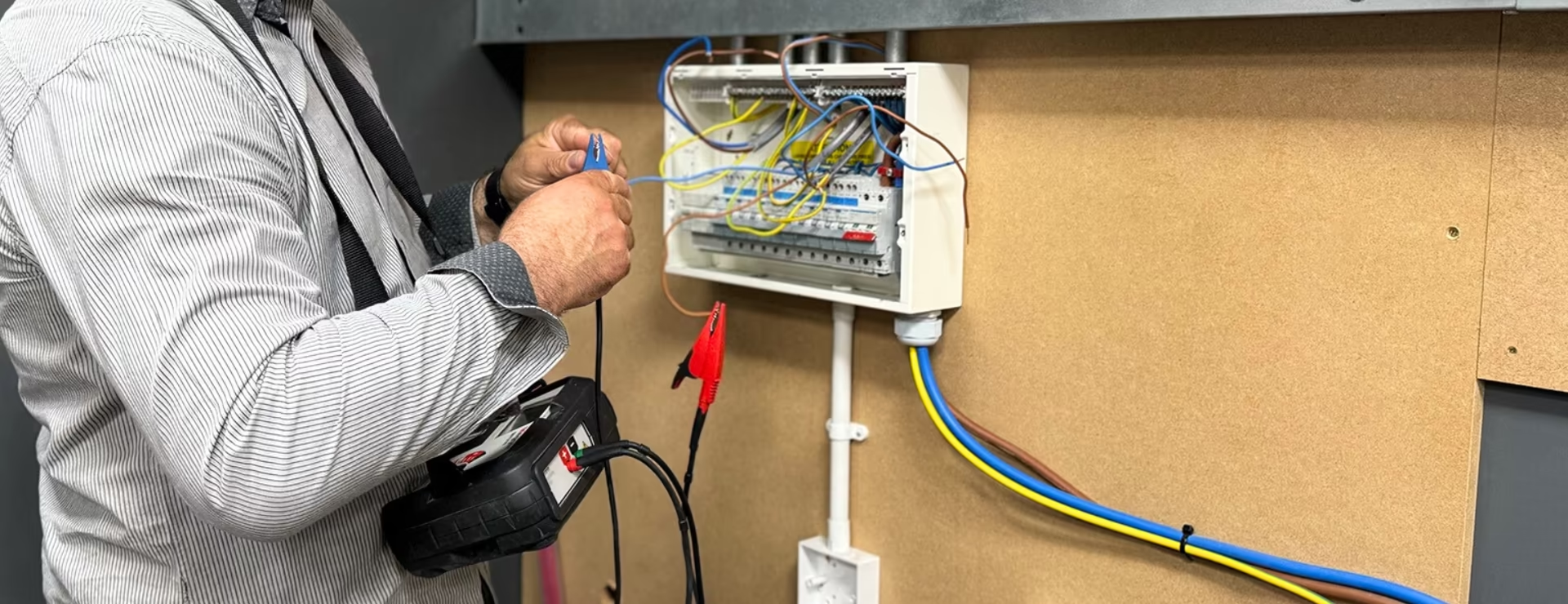
What is the AM2 assessment?
The AM2 (Achievement Measurement 2) is a practical electrotechnical assessment designed and quality‑assured by NET (National Electrotechnical Training). It is usually taken at the end of an electrical apprenticeship or level 3 electrical NVQ to prove that you can work safely, accurately and independently in a real‑world environment.
Across the assessment you’ll work through a series of timed tasks in a purpose‑built bay, following drawings, regulations and job specs rather than being “taught” as you go. Passing the AM2 is a key step towards becoming a fully qualified electrician and is recognised across the UK by employers, JIB and awarding bodies.
Who needs to take AM2?
The AM2 is aimed at people proving occupational competence in electrical installation and maintenance, not complete beginners.
Typical candidates include:
- Advanced electrical apprentices working towards an NVQ Level 3 or equivalent.
- Adult learners following a Level 3 NVQ route who now need an end‑point assessment.
- Existing workers who need to evidence competence for ECS Gold Card or similar schemes.
If you are just starting out and looking to become an electrician, you would normally complete your underpinning knowledge and practical qualifications first, such as Logic4training’s electrician courses for beginners, then progress to NVQ and AM2 later in the journey.
What does the AM2 cover?
NET has structured the AM2 to mirror real‑world electrotechnical work, with a series of timed sections that cover safe isolation, practical installation, inspection and testing, fault‑finding and an applied knowledge assessment.
Section A1: Safe Isolation and Risk Assessment
Duration: 45 minutes
In this section you will demonstrate safe isolation procedures and carry out a risk assessment before starting work. You must prove that you can identify hazards, choose appropriate control measures and isolate equipment or circuits correctly, using the right test instruments and following a documented sequence.
Sections A2-A5: Installation
Duration: 8.5 – 10 hours
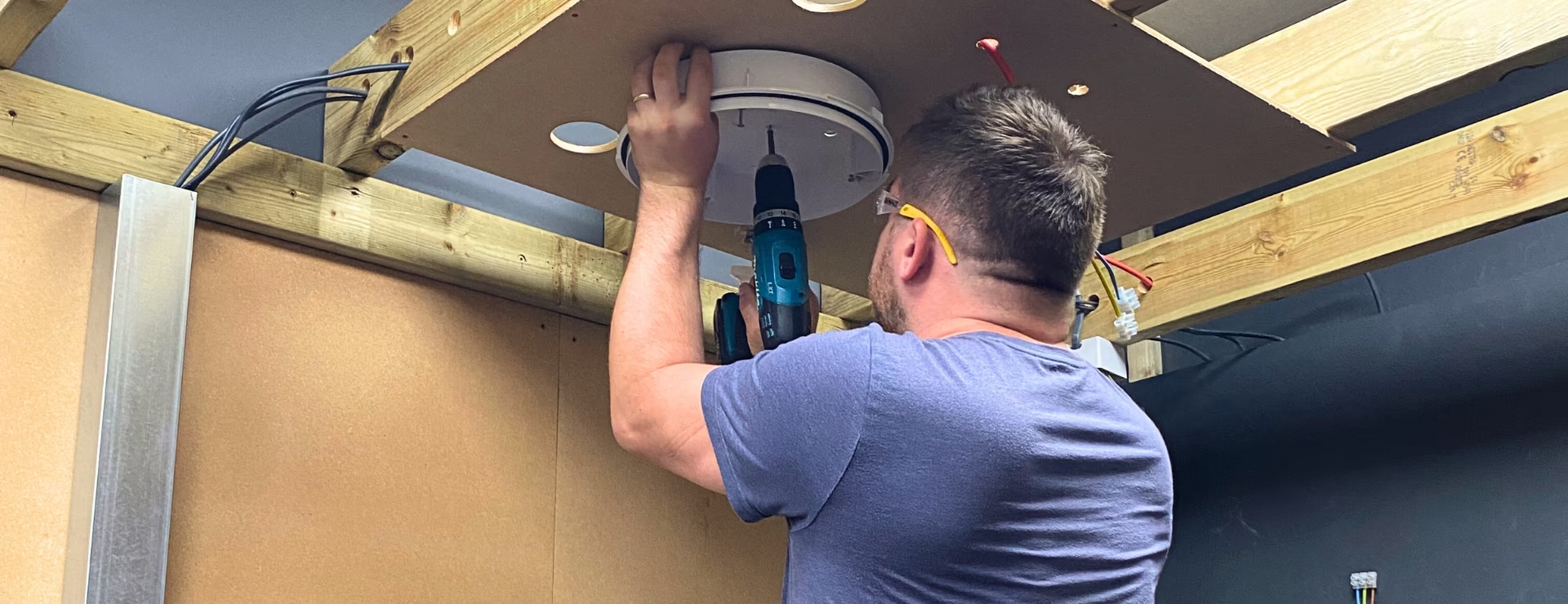
These sections cover the main practical installation tasks. You will install, terminate and connect a range of circuits and equipment to a given specification, including both single‑phase and three‑phase systems.
This typically includes:
- Lighting and power circuits.
- A three‑phase distribution board and associated sub‑circuit.
- A central heating or sustainable energy system.
- Safety services, where specified.
- Data or communication cabling.
You are expected to follow drawings and job specifications accurately, select suitable materials and methods, and complete the work to industry standards within the time allowed.
Section B: Inspection, Testing and Certification
Duration: 3.5 hours
Section B focuses on initial verification of the installation. You will carry out the full sequence of tests using appropriate instruments, in line with BS 7671 and Guidance Note 3. You must record test results clearly and complete the required certification and documentation to a professional standard, showing that the installation is safe for use and compliant with the specification.
Section C: Safe Isolation of Circuits
Duration: 30 minutes
This section checks that you can safely isolate individual circuits before work is carried out. You will follow a recognised safe isolation procedure, including proving your test instrument, confirming the absence of voltage and securing the isolation point. Accuracy, consistency and adherence to safe working practices are all assessed here.
Section D: Fault Diagnosis and Rectification
Duration: 2 hours
In Section D you will diagnose and rectify a selection of pre‑set faults on an existing installation. You will use safe isolation, testing and a logical fault‑finding process to identify the cause of each problem. You are expected to propose suitable remedies, carry out the necessary rectification work and then re‑test to prove that the circuits are safe and functioning correctly.
Section E: Assessment of Applied Knowledge
Duration: 1 hour
This is an online, computer‑based assessment that tests your applied knowledge rather than simple memory. It covers wiring regulations, building regulations, safe working practices and basic design principles. You will need to navigate the regulations efficiently and apply them to practical scenarios that reflect what you have done in the practical sections, rather than just recalling isolated facts.
How is the AM2 assessment structured?
The AM2 is a substantial assessment and not a quick multiple‑choice exam. In most centres, it runs over two and a half days, with around 16-17 hours of assessment time in total. Typically, you will attend the centre for three consecutive days, often two full days plus a shorter day, and work through the practical sections, as well as the online knowledge test, which all follow a set timetable. Your time in each section is controlled by the assessor, with clear start and finish points, so you always know where you are in the process.
Exact daily timings can vary slightly from centre to centre. For example, some may start earlier or run later, but NET fixes the content, structure and marking scheme, so the standard you are measured against is the same wherever you sit AM2.
While every centre publishes its own schedule, most follow a similar pattern:
- Day 1: Induction, health and safety briefing, Section A1 (safe isolation and risk assessment), then the start of the main installation sections (A2-A5).
- Day 2: Completion of composite installation, followed by inspection, testing and certification (Section B).
- Day 3: (Half day) Safe isolation of circuits (Section C), fault diagnosis and rectification (Section D), and the online applied knowledge assessment (Section E).
You will get breaks during the day for food and rest, but the overall time on site is still demanding. Think more like a block of working days on the tools than a single written exam. Being prepared for that level of concentration is just as important as knowing the technical content.
Different AM2 assessments
You may come across 5 different AM2 assessments, which can be a tad confusing. To keep it simple, they all measure the same underlying thing. Can you work safely and competently as an electrician? The only difference is that they are designed for different training pathways.
| Route | AM2 Type | Summary |
|---|---|---|
| Installation & Maintenance Electrician
AM2, AM2S and AM2E share a common structure: safe isolation, composite installation, inspection and testing, fault‑finding and an applied knowledge test. |
AM2: Standard NVQ/framework route | AM2 is the long‑established version used as the final competence check for many Level 3 electrotechnical NVQ routes and older apprenticeship frameworks. It’s typically taken by people completing a 2357‑type NVQ or similar “diploma then NVQ” pathway, rather than the newer Apprenticeship Standard. The focus is on core installation and testing; unlike AM2S/AM2E it generally has less emphasis on additional containment work. |
| AM2S: Apprenticeship Standard end‑point | AM2S is linked directly to the Level 3 Installation and Maintenance Electrician Apprenticeship Standard in England and is taken as part of the End‑Point Assessment for that Standard. Content is very close to AM2 but aligned more tightly to the apprenticeship requirements, with broadened containment and slightly different section labelling and timings. If you’re on the current English apprenticeship, AM2S is almost certainly the version you’ll sit. | |
| AM2E: Experienced worker (installation & maintenance) | AM2E is the Installation & Maintenance assessment for candidates on the Experienced Worker Assessment (EWA) route, for example those completing C&G 2346 who already have substantial on‑site experience. You can only book AM2E once you’ve passed the EWA qualification and gateway checks. Structurally, it mirrors AM2S very closely, with the same broad mix of safe isolation, installation, inspection and testing, fault diagnosis and an online knowledge component. | |
| Domestic Electrician
AM2D and AM2ED cover broadly the same skills as the Installation & Maintenance versions but within a domestic scope. |
AM2D: Domestic electrician apprenticeship | AM2D is the End‑Point Assessment for apprentices on the Domestic Electrician apprenticeship standard. It follows the same core pattern of safe isolation, domestic installation, inspection and testing, fault‑finding and an applied knowledge test, but tasks and scenarios are focused on typical domestic systems. AM2D also includes a scenario‑based professional discussion/interview element linked to the apprenticeship standard, which is specific to that route. |
| AM2ED: Experienced worker (domestic) | AM2ED is the Domestic Electrician equivalent of AM2E. It is taken by experienced workers who are completing a Domestic Experienced Worker Assessment and can only be booked once that qualification is finished. The practical content reflects AM2D (safe isolation, domestic installation work, inspection and testing, and fault‑finding) but without the apprenticeship‑specific interview component. |
Same benchmark, different paths
Across AM2, AM2S, AM2E, AM2D and AM2ED, the assessment standard is consistent: NET expects you to demonstrate safe isolation, sound installation practice, accurate inspection and testing, logical fault‑finding and solid applied knowledge of the regulations, matched to either an installation & maintenance or domestic scope. The version you sit depends on whether you are on a traditional NVQ framework, the current Apprenticeship Standard (inst & maintenance or domestic), or an Experienced Worker route, but in every case, the aim is the same – sign off that you are genuinely competent to work as an electrician in your chosen area.
Entry requirements & when to book
The AM2 is a capstone assessment, so it is important not to book it too early.
Most candidates will have:
- A completed (or near‑completed) Level 3 Electrical NVQ qualification.
- Current knowledge of BS 7671 18th Edition Wiring Regulations and Building Regulations.
- Practical site experience across first‑fix, second‑fix, testing and fault‑finding.
NET provides a Readiness for Assessment checklist to help you and your training provider judge if you are genuinely ready for AM2. Logic4training supports this with its own AM2 revision guides and self‑assessment materials for trainees using our routes.
If you are unsure whether you are at the right stage, have a look at our guide on how long it takes to become an electrician or speak to Logic4training’s electrical team for personalised advice.
Where can you take the AM2?
AM2 is only delivered at NET‑approved assessment centres that meet strict criteria for facilities, equipment and quality assurance.
What they have in common:
- Dedicated AM2 bays with standardised layouts and equipment.
- Separate fault‑finding and installation areas where required.
- Welfare facilities and breakout areas so you can rest properly between sections.
This means that an AM2 in, say, the North of England is directly comparable to an AM2 in the South‑East. The tasks, marking and expected standard are the same.
What to expect on the day
AM2 is run like a formal exam, but it is a very practical, hands‑on one. If you’ve spent time with the NET resources and Logic4training’s revision guides, you should recognise the structure as soon as you step into the centre.
You’ll normally arrive in good time for registration, meet your assessor and complete a bit of paperwork before anything technical starts. Centres are working environments, so you’ll be expected to dress appropriately, bring any required ID and follow site rules from the moment you arrive.
Induction and briefing
Before you pick up a tool, the assessor will carry out an induction.
You can expect:
- A walk‑through of health and safety, fire procedures and emergency exits.
- Centre rules, including what you can and can’t bring into the assessment area.
- An overview of the timetable for each day, including breaks and assessment sections.
This is also your chance to ask practical questions about facilities, where to leave your belongings and how the day will run. Logic4training’s tutors talk through this process with candidates in advance, so when you hear it from the assessor it already feels familiar.
Your assessment bay and paperwork
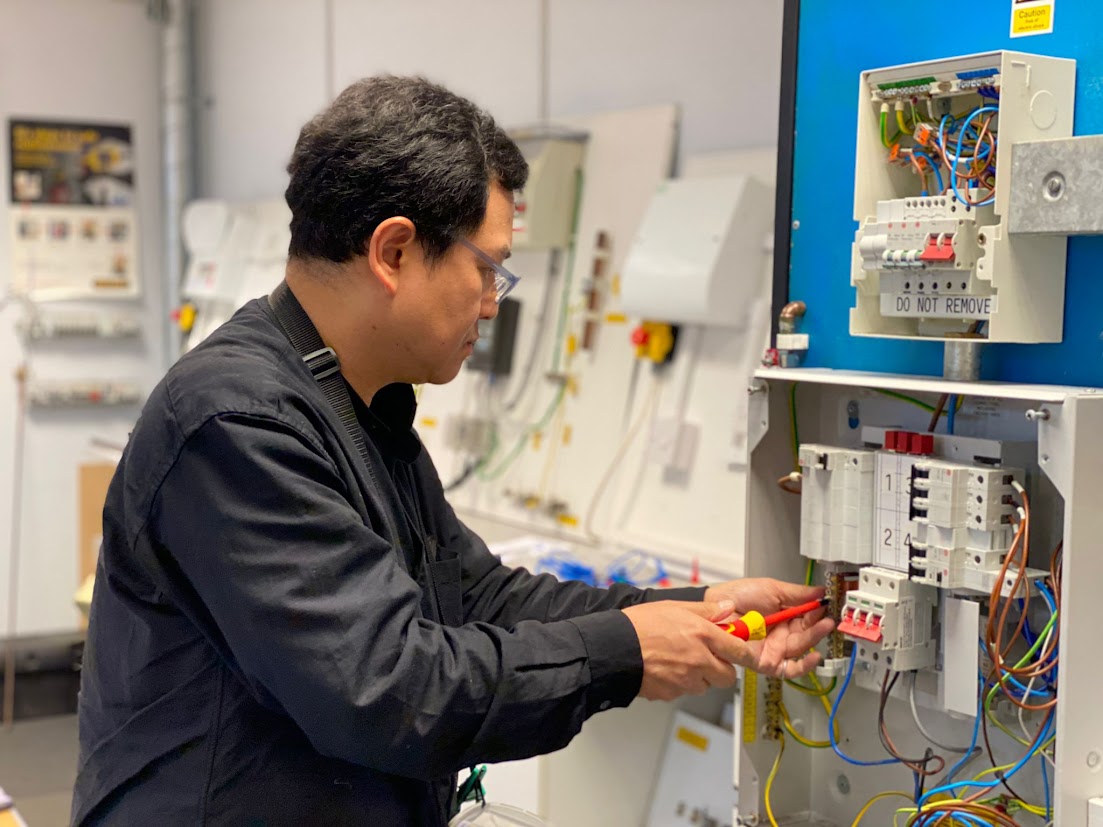
- Each candidate has their own assessment bay laid out to NET’s specification. When you enter the bay, you’ll see:
Clear written instructions for each task. - Wiring diagrams, schematics and installation specifications.
- Marked containment routes and clearly labelled equipment and boards.
In sections where NET allows it, you’ll also have supporting documents such as flow charts, test schedules and relevant extracts from the regulations. The key is to slow down enough to read what’s in front of you and follow it, even if it’s slightly different from how things are done on your current job. At Logic4training, we time in class on reading real specifications and drawings, not just talking about them, so that this part feels natural rather than intimidating
No phones and why that’s a good thing
Once the assessment starts, phones and smart devices are out of the picture. You won’t be allowed to look things up online or ask the person in the next bay what they think.
That can sound daunting, but it keeps the playing field level and makes the qualification meaningful. For most candidates, it also comes as a relief: you can focus on the task in front of you without distractions.
At our training centres, we mirror this exam environment in practice sessions, encouraging you to rely on your training manuals, the regs and your own judgement instead of Google or AI platforms like ChatGPT.
How the assessor works with you
You will be under continuous observation, but the assessor is not there to catch you out.
Typically, they will:
- Stay in or near the assessment area while you work.
- Check that you are following safe systems of work and using tools correctly.
- Tick off criteria against NET’s marking scheme rather than offering coaching or hints.
They may step in if there is a safety concern, or to clarify an instruction, but you should not expect prompts or guidance on how to complete tasks. Our tutors explain this dynamic early on, so you understand the difference between a training session and an assessment and can adjust your mindset when you come to do your AM2 assessment.
Reading time, breaks and pacing yourself
One point that often calms nerves: you get preparation and reading time for each section before the clock starts on the practical work. Use this to:
- Read through the section of the candidate manual that applies.
- Study the drawings, installation spec and any checklists.
- Plan the order you’ll tackle tasks in, so you’re not improvising once you begin.
Across the day you’ll also get scheduled breaks for food, water and a breather; your assessor will tell you when these are during the induction. Simple things like a decent night’s sleep, arriving early and bringing lunch and water make a real difference to how you perform over two‑plus days of testing.
Using the documents in your bay
AM2 is, in effect, an open‑book assessment for the parts where NET allows documentation. You might have:
- The candidate assessment manual.
- Sample forms for inspection and testing.
- Up‑to‑date copies of relevant regulations and guidance.
The challenge is not access to information, but knowing where to find the right section quickly and how to apply it to the job in front of you. At Logic4training, we stress to our students that this is a key skill they need to practise by navigating The Wiring Regulations BS 7671 under mild time pressure. By doing it in the bay, it feels like a repeat performance rather than a first attempt.
Assessment documentation and reference materials such as wiring diagrams, flow charts and relevant regulations will be available in the bay where NET allows. You will need to read these carefully and follow them exactly, rather than rely on “how you do it at work”.
Common AM2 mistakes (and how to avoid them)
NET publishes top tips and common candidate errors, many of which Logic4training sees echoed in the assessment centre. Being aware of these gives you a real advantage.
Typical issues include:
- Not carrying out or documenting safe isolation correctly on every required circuit.
- Installing circuits that do not match the drawings, specs or BS 7671 requirements.
- Selecting the wrong test instrument or missing parts of the test sequence.
- Struggling to navigate BS 7671 and related guidance, leading to incorrect decisions.
- Poor time management, spending too long on one task and rushing the rest.
Logic4training’s AM2 preparation materials focus hard on safe isolation, correct selection and use of test equipment, reading drawings and working methodically under time pressure. Candidates are encouraged to practise full test sequences and documentation until it becomes second nature.
What happens if you fail a section?
The AM2 assessment is marked section by section, with strict criteria for each part. If you fall short, you may not need to repeat the whole assessment.
We know that:
- You will receive a breakdown of your performance, showing which sections you have passed and where you need improvement.
- There is a structured re‑sit policy for AM2, AM2S and AM2E that allows you to re‑take failed sections only, making the process cheaper and faster than a full re‑sit.
Logic4training’s article on changes to the electrotechnical assessment re‑sits policy explains how revised re‑sit rules can save time and money for candidates. After a failed attempt, our tutors can help you interpret the results and plan targeted training before a re‑sit.
How to prepare effectively for AM2
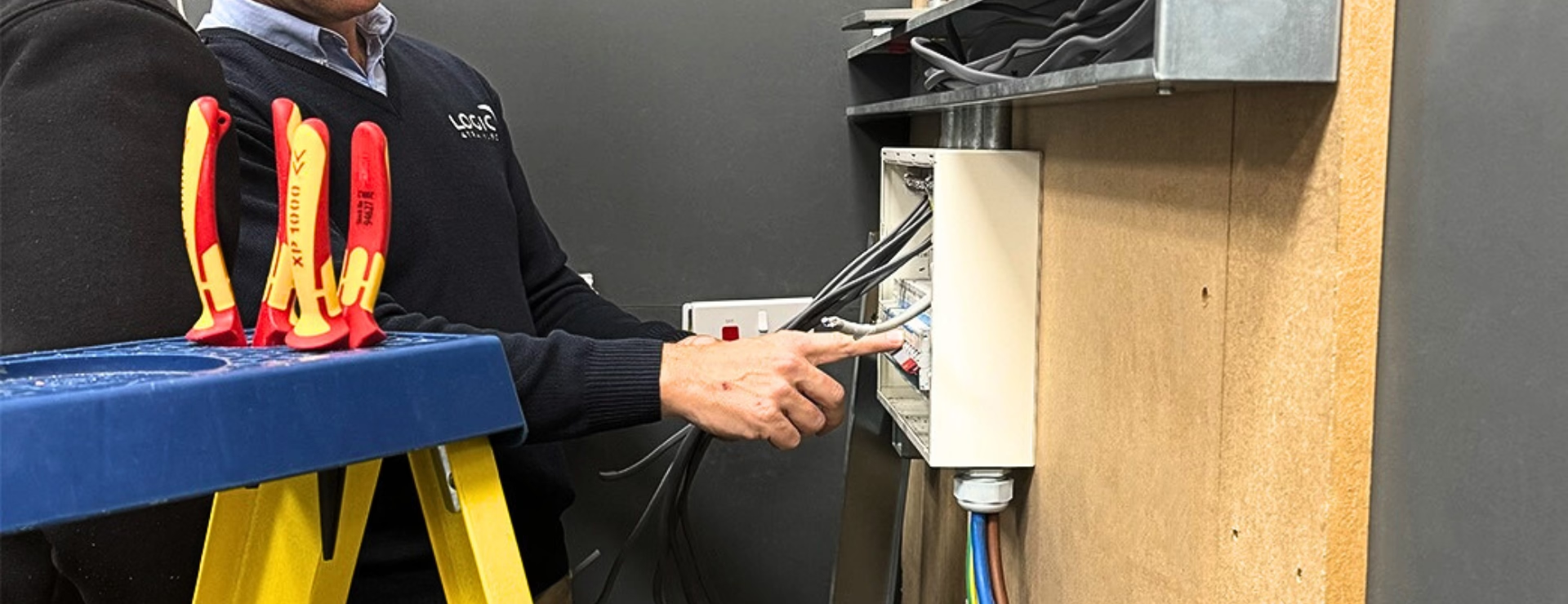
Good AM2 preparation is about targeted practice, not cramming random facts. Logic4training has developed revision guides and checklists specifically to steer this process.
Technical knowledge
Make sure you can confidently:
- Use BS 7671, the On‑Site Guide and Guidance Note 3 to find information quickly.
- Apply building regulations to typical domestic and small commercial installations.
- Recall standard test values, inspection items and documentation requirements.
- Understand three‑phase systems, protective devices, RCDs and fault protection.
Practical skills
You should practise:
- Full safe isolation routines (proving unit, locks, tags, re‑test etc.).
- First‑fix and second‑fix to a drawing, including containment and terminations.
- Complete test sequences on different circuit types with correct instruments.
- Logical fault‑finding: observe symptoms, test, narrow the problem, fix, re‑test.
Our electrical training centres in Northolt, Luton, Basildon and Sittingbourne give candidates access to realistic rigs, current test equipment and experienced tutors, which helps bridge the gap between college and the AM2 bay.
How Logic4training supports AM2 candidates
Logic4training has been delivering construction and building services training for over 20 years, with thousands of learners progressing into electrical careers. That experience feeds directly into the way we prepare people for AM2.
Key elements of Logic4training’s support include:
- Experienced electrical tutors: Our electrical trainers are all fully qualified electricians with site backgrounds who understand both the NVQ route and NET’s expectations, helping you interpret the standards properly.
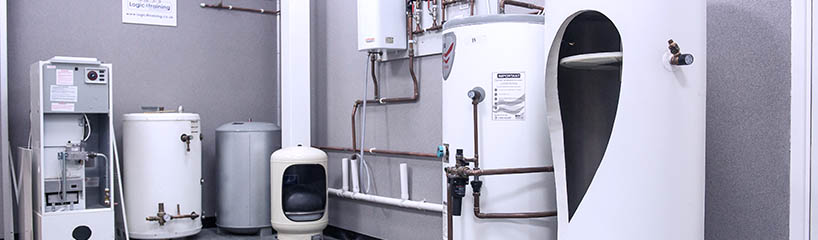
- Modern training environments: Centres fitted with real‑world equipment and realistic installation scenarios so your practice mirrors what you will see during assessment.
- Clear progression pathways: From beginner electrician courses through to advanced qualifications, we offer structured, supported routes into the trade and beyond.
If you are looking at a career change or want to retrain as an electrician, our guide Retrain as an Electrician in 2026 explains the different paths and where AM2 fits into them.
Advanced electrical qualifications
Common electrical jobs & day rates
FAQs
How does the AM2 fit into my career path as an electrician?
AM2 is not just another exam; it is a key milestone that proves you are a competent electrician ready to work without supervision. It acts as the capstone practical assessment that sits alongside your NVQ Level 3 or equivalent qualification.
Once you have passed AM2 and completed your NVQ Level 3, you can usually:
- Apply for an ECS Gold Card, which is widely recognised by employers and clients as proof that you are a fully qualified Installation Electrician.
- Move into better‑paid roles or self‑employment, supported by industry‑recognised credentials that demonstrate your practical competence.
- Progress onto more advanced training such as EV charging, solar PV or inspection and testing upgrades, many of which Logic4training offers as part of its electrical training portfolio.
If you are planning your route into the trade, Logic4training’s guides on how to become an electrician and how long it takes to become an electrician set out the step‑by‑step journey from complete beginner through to NVQ, AM2 and beyond.
Is the AM2 assessment hard?
AM2 is demanding because it is designed to reflect the standard expected of a fully qualified electrician, but it is not there to trick you. If you have solid site experience, up‑to‑date knowledge of BS 7671 and have used good quality revision materials, it is very achievable.
Candidates often find the hardest parts are:
- Managing time across long, intensive assessment days.
- Carrying out safe isolation and test procedures perfectly under exam pressure.
- Staying calm when faced with an unfamiliar scenario or unexpected fault.
Logic4training’s approach is to demystify the assessment by walking you through the format, common mistakes and best practices well before you step into the bay.
Do I need AM2 to get an ECS Gold Card?
For most modern routes, AM2 (or AM2S/AM2E, depending on your pathway) is a mandatory requirement for achieving an Installation Electrician ECS Gold Card. The Gold Card confirms that you hold an NVQ Level 3 plus the recognised practical end‑point assessment and are competent to work unsupervised.
Some older “legacy” routes allowed Gold Card status without AM2, but current standard pathways expect NVQ Level 3 plus AM2 or equivalent. Logic4training’s career guides and course advisors can help you understand which route applies to you and how AM2 fits into your specific path.
How can I make passing AM2 more likely the first time?
The best way to boost your chances is to combine hands‑on practice with structured revision and familiarity with NET’s documentation. That means practising safe isolation, installation, inspection and testing, and fault‑finding in conditions as close as possible to the assessment bay
Logic4training helps by providing:
- AM2‑focused revision and checklists for the assessment structure.
- Training centres with realistic rigs, current test instruments and experienced tutors who understand NET expectations.
- Clear guidance on using NET’s pre‑assessment manual and candidate resources so you know exactly what will be expected on the day.
What should I do after passing AM2?
Once you have passed AM2 and completed your NVQ Level 3, the next step is usually to apply for your Installation Electrician ECS Gold Card and update your CV or portfolio to reflect your new status. This makes you more attractive to employers and clients and can open up higher‑paid roles or self‑employed opportunities.
You can then look at adding higher‑level skills such as EV charging point installation, solar PV, battery storage or advanced inspection and testing. Logic4training delivers a wide range of follow‑on electrical courses, helping you build a long‑term career path rather than just stopping at AM2.


 Your latest offers & alerts