
Commercial gas qualifications use ACS module codes to identify specific areas of work. In this article, we'll explain the main commercial gas module codes, what each covers and which qualifications you need before booking. You can compare individual courses through our commercial ACS gas modules page.
TL;DR
What you need to know:
- ICPN1 covers first-fix installation of commercial gas pipework.
- TPCP1 and TPCP1A cover tightness testing and purging. Volume, pressure, pipe diameter and gas type affect which assessment you need.
- CDGA1 covers direct-fired commercial heating appliances. CIGA1 covers indirect-fired appliances.
- CORT1 covers overhead radiant tube and plaque heaters. CGFE1 covers gas-fuelled engines.
- Appliance modules normally require COCN1 or CODNCO1. COCN1PILS is a separate limited-scope route, not a general substitute.
- Your current Gas Safe registration must cover the work you undertake. Passing an assessment does not replace registration.
Commercial Gas Module Codes at a Glance
Use this table to identify the relevant module, then check its full scope and entry requirements before booking.
Appliance prerequisites and any restrictions still need to be checked against the individual course and your existing certificates.
What Are ACS Commercial Gas Modules?
ACS stands for Accredited Certification Scheme. It is the assessment scheme through which gas operatives demonstrate competence against nationally agreed criteria for particular areas of gas work. Commercial ACS modules separate core gas safety knowledge from specific pipework, testing and appliance activities.
For commercial heating appliance work, the usual core routes are:
- COCN1: Core Commercial Gas Safety.
- CODNCO1: Changeover Domestic to Commercial Gas Safety, for engineers with the appropriate domestic core qualification.
Engineers then take the appliance and pipework assessments needed for their work. Holding a core certificate does not automatically cover every commercial appliance.
Do not confuse COCN1 with COCN1PILS. Our COCN1PILS with ICPN1 route combines a limited-scope pipework core with first-fix pipework installation. It is not the standard entry qualification for appliance modules.
ACS certification and Gas Safe Register registration are also different. Certificates provide evidence of competence; registration records the categories of work an engineer can undertake. Relevant qualifications must be recorded and the registration must be current before work begins.
When certification expires, you cannot continue working in the affected category. An expired core can have wider consequences for the categories it supports.
ICPN1: Commercial Pipework Installation
ICPN1 covers first-fix installation of commercial gas pipework. It suits experienced operatives whose role includes installing pipework that transports gas around a commercial premises.
The important distinction is between installing pipework and testing or purging it. ICPN1 is the installation module. TPCP1 or TPCP1A provides the separate testing and purging assessment where that work forms part of your role.
Logic4training offers an ICPN1 commercial pipework course and the combined COCN1PILS with ICPN1 assessment. The latter is a restricted pipework route: its published scope does not permit the live gas supply to be connected to an appliance.
Engineers taking appliance modules may also need ICPN1 because of the associated pipework scope. Ask our team to check the installation details and your existing certificates rather than assuming an appliance qualification covers all connected pipework.
TPCP1 and TPCP1A: Testing and Purging
TPCP1 covers testing and purging of installations exceeding one cubic metre. TPCP1A covers natural gas installations not exceeding one cubic metre, provided they also stay within its pressure and pipe-diameter limits.
The published TPCP1A scope is:
- Installation volume not exceeding 1m³.
- Pressure not exceeding 40 mbar.
- Pipe diameter not exceeding 150mm.
- Natural gas only.
Volume is therefore not the only deciding factor. A system below 1m³ is not automatically within TPCP1A if another limit is exceeded.
Our TPCP1 course covers larger installations and a wider pressure range. LPG work also requires an appropriate LPG core or changeover certificate.
Both modules address tightness testing and purging. Tightness testing checks pipework for leakage. Purging safely displaces air or gas as required when bringing an installation into service or taking it out of service.
These assessments are separate from ICPN1, even when booked within the same package. If your contracts include testing and commissioning commercial pipework, check whether TPCP1A or TPCP1 matches the systems involved.
CDGA1: Direct Fired Gas Appliances
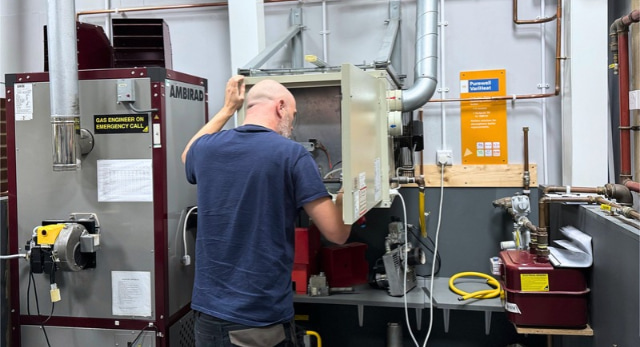
CDGA1 covers direct-fired commercial heating appliances, where combustion products enter the space being heated rather than being discharged outside through a chimney.
Examples include suitable direct-fired air heaters used in large greenhouses and open warehouses. The module covers commissioning, servicing and repair of equipment within its specified range. It should not be treated as a catch-all qualification for every appliance or industrial process involving a direct flame.
Entry normally requires COCN1 or CODNCO1, plus ICPN1 where the associated pipework requires it.
There is an additional booking condition at Logic4training. Engineers taking CDGA1 individually must provide valid CIGA and CORT certificates dated within the previous three months. Otherwise, the module is offered within a package alongside those assessments.
Check the current requirements on our CDGA1 direct fired gas appliances course page before booking.
CIGA1: Indirect Fired Gas Appliances
CIGA1 covers commissioning, servicing and repair of indirect-fired commercial appliances, including relevant boilers and warm-air heaters.
With indirect-fired equipment, heat transfers through a heat exchanger rather than combustion products being discharged directly into the heated air. This is the key distinction from the direct-fired appliances covered by CDGA1.
Logic4training’s published CIGA1 range includes non-domestic forced-convection air heaters and gas-fired hot-water boilers with rated heat inputs between 70kW and 2MW. It also identifies internally installed gas-fired absorption heat pumps within its scope.
Entry requires COCN1 or CODNCO1, with ICPN1 added where the pipework scope requires it. CODNCO1 is therefore one accepted route, not the only one.
The CIGA1 indirect fired gas appliances course is often taken within a commercial package. It can also be booked individually when the entry requirements are met.
CORT1: Radiant Tube and Plaque Heaters
CORT1 covers overhead radiant tube and plaque heaters. These appliances are commonly found in warehouses, workshops and other large commercial or industrial spaces.
The module covers commissioning, servicing and repair. Its published range includes overhead luminous plaque heaters and both flueless and flued overhead radiant tube heaters.
Entry normally requires COCN1 or CODNCO1, plus ICPN1 where needed for the associated pipework.
Our CORT1 radiant tube and plaque heaters course is available within the Core Commercial Heating Gas Safety package, alongside CIGA1, CDGA1 and other commercial assessments. Covering several appliance types makes sense where an engineer maintains a mixed commercial heating estate.
CGFE1: Gas Fuelled Engines
CGFE1 covers gas-fuelled spark-ignition and dual-fuelled engines. For work involving combined heat and power plant, check that the engine, installation and intended activities fall within the assessment agreed with our technical team.
Logic4training delivers this course at the operatives’ workplace for a maximum of four people. Before training, a member of our technical team carries out a site survey to confirm that the equipment meets ACS assessment requirements.
The normal entry qualification is COCN1 or CODNCO1. A restricted alternative is available in certain circumstances for engineers responsible only for engine maintenance and servicing, not installation, where the engine is housed alone in an acoustically isolated plant room.
That restricted route needs individual review. It must not be read as permission to undertake other gas installation work. See the CGFE1 gas fuelled engines course for details.
Other Commercial Gas Module Codes
BMP1 covers commercial gas boosters, associated controls and pipework within its stated pressure range. See our BMP1 gas boosters course.
EFJLP1 covers electrofusion jointing of polyethylene pipework for low-pressure gas installations. See our EFJLP1 electro fusion jointing course.
Which Commercial Gas Modules Do You Need?
Start with the work, not the longest list of codes. Identify the appliances, gas type, pipework and activities your contracts involve, then match those requirements to your existing competence and the relevant assessments.
- Domestic engineer adding commercial heating: follow the appropriate first-time commercial upskill route. The Commercial Heating Changeover package is described as a renewal option, so check suitability before booking.
- Commercial engineer renewing qualifications: consider the Core Commercial Heating Gas Safety package, with the assessments needed for your existing work.
- Pipework installer: consider COCN1PILS with ICPN1 where its restricted scope fits, adding TPCP1 or TPCP1A if testing and purging are required.
- Engineer adding one specialist category: check the individual module’s prerequisites and whether a standalone assessment is available.
For the wider entry routes, read our guide to becoming a commercial gas engineer. Our ACS assessment and appliance codes guide explains the domestic categories that engineers may already hold.
Compare our commercial gas packages for current course details.
To Wrap This Up
Each commercial ACS code identifies a defined area of competence, not unrestricted permission to work on every commercial gas system. Appliance modules normally sit alongside an appropriate commercial core, while pipework installation and testing have their own assessments.
Not sure which commercial gas modules your contracts call for? Speak to our team, and we’ll help you choose, or compare every module on our commercial ACS gas modules page.
Frequently Asked Questions
What does ACS stand for in gas training?
ACS stands for Accredited Certification Scheme. It assesses gas operatives against nationally agreed competence criteria and provides recognised evidence of competence for Gas Safe registration.
What is the difference between TPCP1 and TPCP1A?
TPCP1 covers testing and purging of installations exceeding 1m³ within its assessed scope. TPCP1A covers natural gas installations not exceeding 1m³, 40 mbar pressure and 150mm pipe diameter. Volume alone does not determine which module is suitable.
Do I need core commercial certification before taking an appliance module?
Normally, commercial heating appliance modules require COCN1 or CODNCO1, plus any additional prerequisites stated for the module. COCN1PILS with ICPN1 is a limited-scope pipework route, not the standard core prerequisite for appliance assessments. Individual modules may have further conditions or a specifically approved restricted route.
Can a domestic gas engineer work on commercial appliances?
Domestic ACS categories alone do not cover non-domestic appliance work. Engineers need the appropriate commercial competence and current Gas Safe work categories before undertaking it. Read our commercial gas engineer guide for the domestic-to-commercial route.
How long are commercial gas modules valid for?
Commercial ACS certificates normally last five years, and reassessment should be completed before the relevant certification expires. You must stop work in any category no longer supported by current certification and registration. Gas Safe Register registration is renewed separately and does not extend an ACS certificate’s validity.


 Your latest offers & alerts